

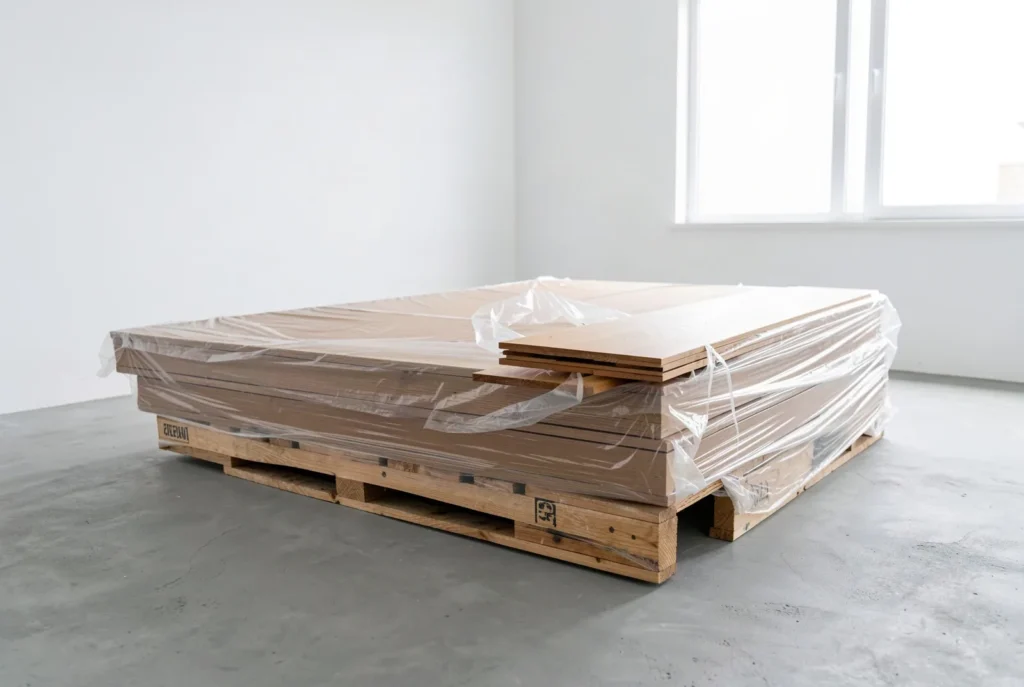
The short answer: open and check your packs on delivery, before any installation. Count the area, verify the reference, thickness and grade, and look at boards from every pack. The absolute rule: a laid board is an accepted board. A defect spotted before installation is easily resolved; the same defect afterwards is far harder to address.
What to check when the pallet arrives
Wood flooring is delivered on a wrapped pallet. The carrier rarely waits, but a few minutes of checking beats weeks of discussion: the state of the wrapping and the pallet — torn film or a broken pallet signals rough handling or exposure to damp; the number of packs against the delivery note; signs of moisture such as buckled cardboard, tide marks or one pack noticeably heavier than the others; and crushed corners, which point to damaged boards at the edge of the load.
If anything is visibly wrong, write precise reservations on the transport document before signing. A generic mention such as “subject to unpacking” carries little weight: describe what you can see, and photograph the pallet before unloading. See pallet delivery and reception.
What to check before laying
- Reference and batch. Check that all packs carry the same reference and, if possible, the same production batch.
- Dimensions. Measure overall thickness and width on a few boards.
- Total area. Recount; square metres per pack are printed on the packaging.
- Grade. Open several packs, not just the first, and lay out thirty or so boards on the floor. That is the only way to judge a grade, which describes an average distribution and not each individual board.
- Finish. Look in raking light: the appearance should be consistent from pack to pack.
- Board flatness. Put two boards together: they should engage with no gap and no height difference.
What is normal on natural wood?
This is the most frequent source of misunderstanding. Wood is a natural product, not a uniform industrial one.
| Characteristic | Status |
|---|---|
| Knots, according to the grade ordered | Normal — that is the definition of the grade |
| Colour variation between boards | Normal — spread it by mixing packs |
| Sapwood, medullary rays, cross grain | Normal depending on grade |
| Filled knots | Normal on rustic grades |
| Slight difference between two batches | Expected — order in one go |
| A few short boards in the pack | Normal, allowed for in the yield |
| Board split through | Defect |
| Broken joint or out-of-tolerance machining | Defect |
| Missing or patchy finish | Defect |
| Swollen, cupped or damp boards | Defect |
See wood flooring grades and how much to order.
Why “a laid board is an accepted board”
It is the constant professional rule, and it is logical. By laying a board you implicitly accept its appearance, and once it is glued or clicked in it becomes impossible to distinguish an original defect from damage caused during installation or use. So never lay a board whose appearance surprises you: set it aside, photograph it, and take stock before continuing. The same applies to a professional fitter, whose duty of advice requires flagging an anomaly before installing, not after.
If something is wrong
Stop laying immediately — continuing weakens your position considerably. Photograph the overall view, the detail of the defect and the pack label with reference and batch. Keep the packaging and the boards concerned, note how many boards are affected and what proportion of the total that represents, then contact us with those elements. A documented file is dealt with far faster than a verbal description.
What belongs to the installation, not the product
- A floor that lifts: insufficient perimeter gap, nine times out of ten — see expansion gaps.
- Springy or hollow-sounding areas: flatness of the subfloor — see levelling and flatness.
- Gaps between boards in winter: air too dry — see humidity and wood floors.
- General swelling: laid without acclimatisation or over a damp substrate — see acclimatisation.
Frequently asked questions
Should I open the packs on delivery or wait?
Open two or three quickly for a visual check. Leave the others closed during acclimatisation: the wood should balance inside its packaging.
Can I refuse a delivery?
Yes, if the goods are obviously damaged. It is usually better to accept with detailed written reservations: that lets you examine the actual contents and avoids a long round trip.
Is a colour difference between two packs a defect?
No, within the variation expected for the grade. Good practice is to draw from several packs at once during installation so the shades are spread rather than grouped. See choosing a tone.