


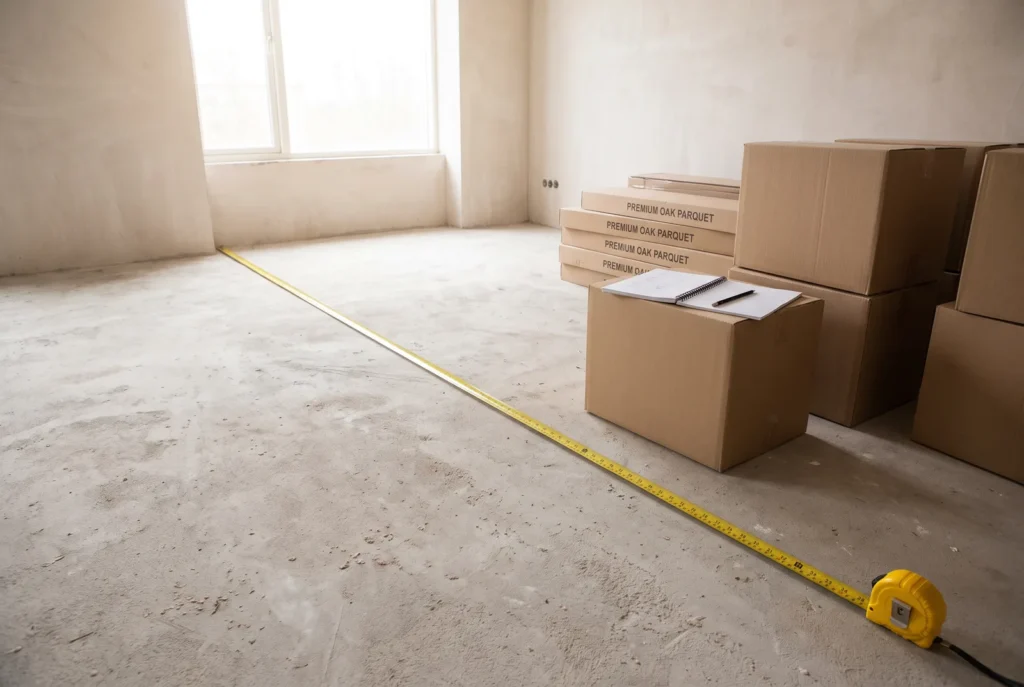
It is the question that comes up most often, and the most expensive mistake. Ordering the exact area of the room guarantees you will run short. Here is how to get the calculation right first time.
Why you must order more
Every board cut at the end of a row leaves an offcut. If the remaining piece is over 30 cm, it starts the next row and nothing is lost. If it is 12 cm, it goes in the bin. Multiplied by the number of rows, that adds up to several square metres.
Add to that the cuts around obstacles — posts, thresholds, radiators, a kitchen island — and the boards set aside when you open the packs because a defect does not suit you.
Waste factors by pattern
| Pattern | Allow for |
|---|---|
| Straight planks, simple rectangular room | 5–8% |
| Straight planks, complex room (angles, recesses, corridor) | 10% |
| Diagonal | 10–12% |
| Herringbone | 10–15% |
| Chevron | 12–15% |
| Versailles panels | 15% |
The differences make sense: with chevron, every board is cut on an angle, and the offcut from a 45° or 60° cut is almost never reusable.
The calculation, step by step
- Measure the actual area. Length × width for each rectangular section, added together. Do not deduct small obstacles: a 2 m² island does not save 2 m² of flooring, because the cuts around it generate their own waste.
- Add the waste factor for your pattern.
- Round up to a whole pack. Flooring is sold by the full pack, not by the individual square metre.
A concrete example: a 32 m² living room laid straight in a room with two returns. 32 × 1.08 = 34.6 m². If a pack covers 2.18 m², you need 16 packs, i.e. 34.88 m². You order 16 packs.
The top-up trap
This is the real subject, and the reason it is better to order generously.
Wood is a natural material, cut in batches. Two orders of the same product placed three months apart can come from two different production batches, with a slightly shifted tone. On a natural oiled floor the difference can be visible. On a fumed or whitened tone it almost always is.
And a reference can simply no longer be available — common with end-of-line and clearance batches.
Conclusion: two packs too many beats two square metres too few. Surplus packs become your reserve for a future repair — a board damaged in five years is then replaced with wood from the same batch.
Always keep a reserve
Beyond the waste allowance, plan for one reserve pack stored flat, in a dry room, inside the home. That is what lets you, years later, replace a board burnt by a stove or swollen by a leak without redoing the whole room.
Special cases
- Several rooms at once: order everything together. It is the best way to get a consistent batch throughout, and it lowers the overall waste since offcuts from one room serve in another.
- Narrow corridor: the waste factor climbs fast. Allow 12% even laid straight.
- Very long boards: the longer the board, the bigger the end-of-row offcut can be. Add one or two points.
In doubt? Ask
Send us the dimensions of your room and the pattern you have in mind: we will work out the exact number of packs for the reference you are interested in. It is free and it avoids a nasty surprise on delivery.
Sources
- CSTB — standards for wood flooring installation.