

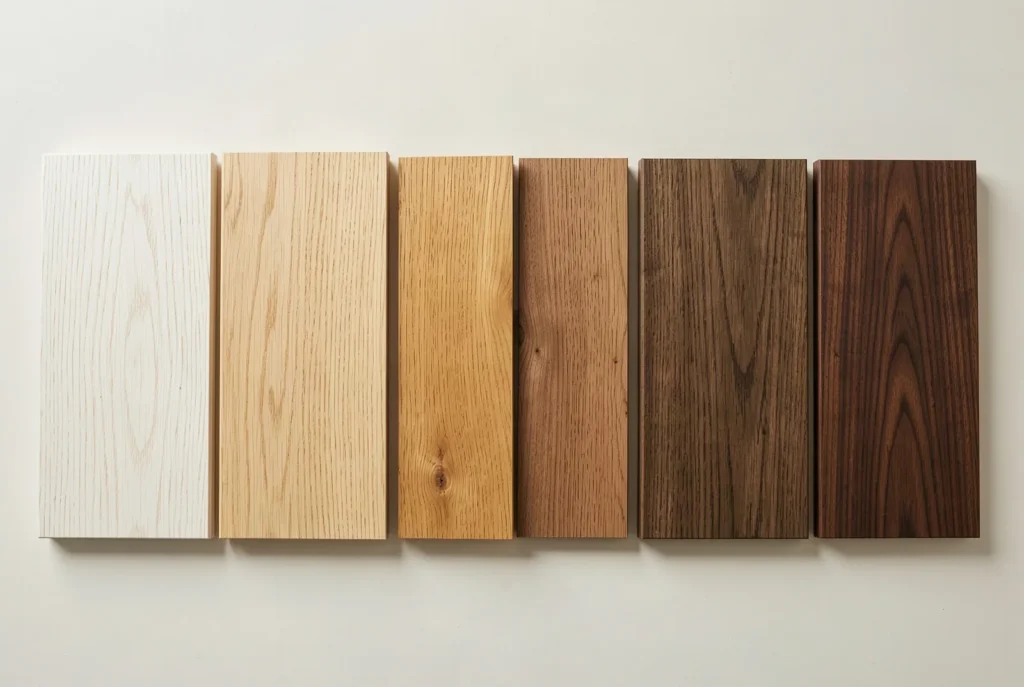
The short answer: start from the natural light in the room, not from the catalogue. A dim or north-facing room calls for a pale to natural tone; a very bright space can carry smoked oak or a dark oil. If you hesitate, mid natural oak is the tone that dates least and suits the widest range of furniture.
How light changes a tone
The same reference does not look the same in two homes. Three factors explain the gap. Orientation: northern light is cool and even, greying the tones and bringing out ashy undertones, while southern light warms the wood and lifts the honey notes. Quantity of light: a dark floor absorbs it, and in an already dim room it produces a cellar effect that no amount of artificial lighting fixes. Artificial lighting: warm light at 2,700 K makes natural oak golden, neutral light at 4,000 K makes it noticeably grey — the source of many disappointments.
The practical consequence: always judge a tone in the room concerned, laid flat on the floor, and look at it morning, afternoon and evening under the real lighting.
The main families
| Family | Effect | What shows | From (incl. VAT) |
|---|---|---|---|
| Whitewashed / limed oak | Enlarges, very bright, Nordic feel | Dust hidden, dark crumbs visible | €32.40/m² |
| Pale natural oak | The most versatile, timeless | Balanced | €22.80/m² |
| Mid natural / honey oak | Warm, classic | The most forgiving | €25.92/m² |
| Smoked oak | Strong character, cocooning | Pale dust very visible | €38.40/m² |
| Walnut and dark woods | Luxurious, high contrast | Dust and marks very visible | €56.82/m² |
Browse our Nordic tones, smoked oak and walnut.
Which tone shows the least dirt?
Badly framed question, useful answer: neither, they simply show different things. A very dark floor reveals pale dust, footprints and drying marks; a very pale one shows hairs, crumbs and dark stains. The everyday winner is mid natural oak in a slightly marked grade: the natural variation, knots and contrasts confuse the eye and hide daily life. See the grades and our rustic oak.
The finish counts as much as the tone
Two boards of identical tone read differently depending on the finish. Matt oil keeps the depth of the wood and reads slightly warmer; matt lacquer looks close, with a protective film; satin or gloss lacquer reflects light, which lifts the perceived brightness but accentuates reflections and scratches; brushing deepens the soft grain and therefore the contrast. See oiled, lacquered or unfinished and brushed, hand-scraped, aged.
Will the tone change over time?
Always, and you should plan for it. Oak darkens and patinates under light: a pale floor takes on golden tones over the years. A rug or a piece of furniture left in place for years creates a less exposed, paler patch that appears the day you move it. The difference evens out over a few months, but it surprises people.
Frequently asked questions
Does a pale floor really make a room bigger?
Yes, measurably: a light surface reflects more light, which pushes the perceived limits of the room outwards. See white and limed wood floors.
Can an existing floor be re-tinted?
Yes, by sanding and applying a tinted oil or lacquer. It is a heavy job but it changes the whole atmosphere without replacing the floor. See sanding and refinishing.
Are all boards in a batch identical?
No, and that is normal — wood is a natural material. Mix the packs during installation so the shades are spread rather than grouped. Order the whole project at once: production batches vary.