


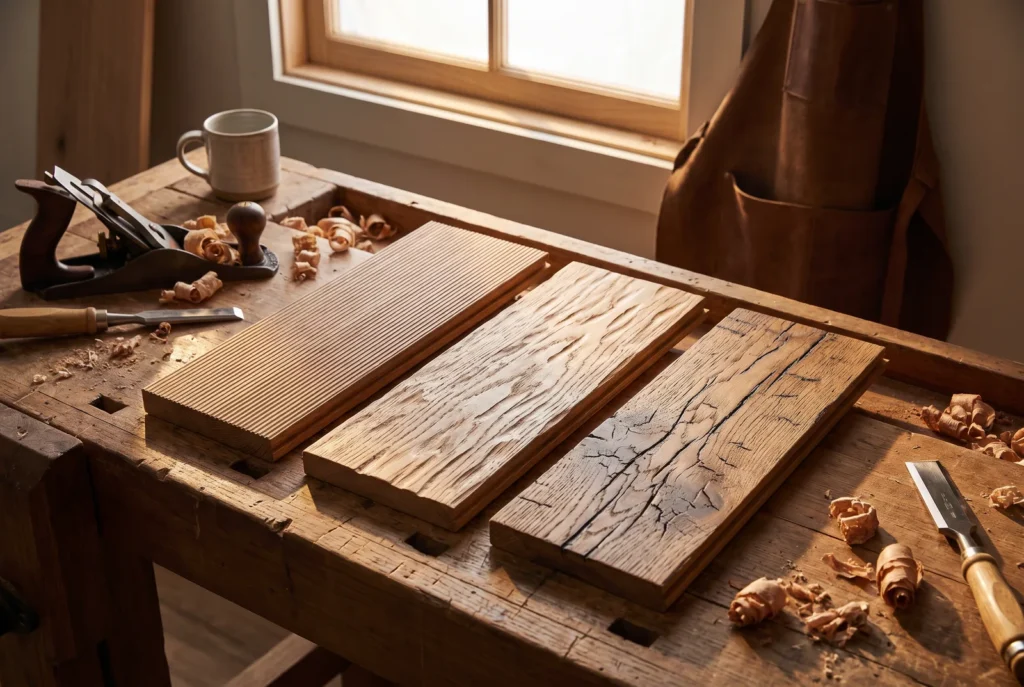
Texture and finish are often confused. The finish — oil, lacquer — protects the wood. The texture sculpts its surface before any protection. It changes the feel, the way light catches, and above all how the floor absorbs time.
Smooth: the neutral surface
The wood is simply sanded, with no relief. It is the most common and the most discreet texture.
- Look — crisp, contemporary, uniform. Light slides across it.
- Feel — perfectly flat.
- The thing to know — a smooth surface hides nothing. Every scratch, every speck of dust shows. On a dark or very pale tone, even more so.
Brushed: the relief of the grain
A wire brush passes over the wood and attacks the soft parts while sparing the hard ones. The result is a relief that follows the natural figure — a few tenths of a millimetre, clearly felt under the hand.
- Look — the figure of the wood comes forward, the surface catches light in a lively way.
- Feel — slightly textured, pleasant barefoot.
- The decisive advantage — brushing hides marks of use. A fine scratch is lost in the relief instead of standing out. It is the best choice with children or pets.
- The trade-off — dust settles in the hollows. A vacuum handles it very well, a mop less so.
A distinction is made between light brushing, which just adds grain, and deep brushing, which is frankly sculpted.
Hand-scraped: the workshop hand
The surface is worked to imitate hand planing: broad, irregular undulations, visible in raking light. It is a strong texture that gives a floor the character of age.
- Look — warm, artisanal, very pronounced.
- Be aware — it is a strong aesthetic commitment. In a contemporary interior it can clash. In a period house it is superb.
- Upkeep — a little more demanding, the hollows hold more.
Aged: simulated patina
This is a set of combined treatments: brushing, rounded edges, sometimes deliberate marks and knocks, uneven colour. The aim is to give a new floor the appearance of one that is fifty years old.
The result is striking in the right setting. You simply have to accept that it is an effect, deliberately so, and that it will itself age on top.
Bevels, which add to all of this
The bevel is the small chamfer on the edge of the board, which draws a groove between each board once laid. It combines with any texture and changes the reading considerably — it emphasises each individual board, particularly on wide formats.
How to choose
| Your priority | Texture |
|---|---|
| A floor that forgives daily use | Brushed |
| A clean contemporary look | Smooth |
| Character, an older spirit | Hand-scraped or aged |
| The least possible upkeep | Smooth or lightly brushed |
| The most pleasant barefoot | Brushed |
Texture and grade go together
Deep brushing on a perfectly uniform Prime grade produces an odd result: plenty of relief, no character. Conversely, a smooth rustic grade leaves the knots bare and a little raw. The combinations that work best pair a pronounced texture with a grade that has character.
It cannot be judged from a photograph
This is the property that translates worst to a screen: brushing barely shows in an image and is felt immediately under the hand. Ask for a sample and run your palm over it — the decision takes three seconds.