

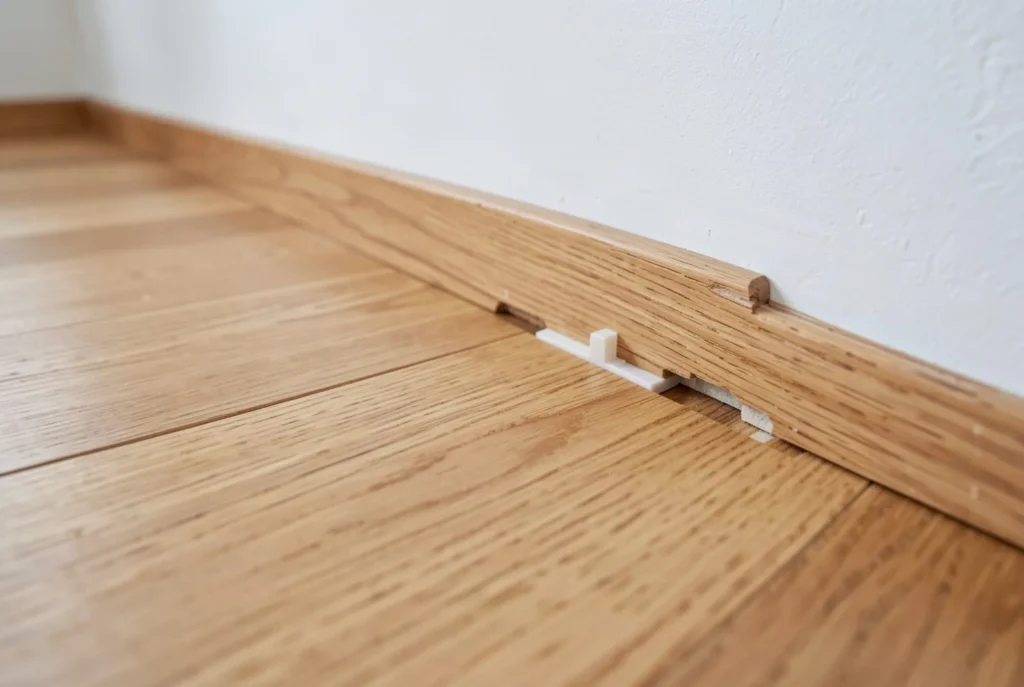
The short answer: a wood floor must be free to expand all around its perimeter. Allow at least 8 mm against every wall and fixed point, and an expansion break beyond roughly 8 m in one direction or between two rooms. A floor that cannot expand does not stay put: it lifts.
Why wood has to move
Wood is hygroscopic: it takes up and releases moisture until it balances with the surrounding air. In winter, heating dries the atmosphere and the boards shrink. In summer they take moisture back and swell. Per board the movement is small, but it adds up: across a room 6 m wide, a normal seasonal swing can amount to several millimetres. If the floor is trapped against a wall at each end, that expansion has nowhere to go and the floor domes in the middle or the joints override each other. This is by far the leading cause of failure on installed floors — and it is entirely avoidable. See humidity and wood floors.
The perimeter gap
This is the space left between the floor and every fixed element of the building. It must be respected all the way round, without exception: against walls and partitions, around heating pipes and columns, against door thresholds and frames, at a post or a fixed unit, and against a stove or fireplace hearth.
The usual figure is 8 mm minimum. On large rooms the working rule is roughly 1.5 mm per metre of room width, keeping that 8 mm floor. A room 8 m across therefore justifies about 12 mm. The gap is then hidden by skirting boards, which must be fixed to the wall and never to the floor — a skirting nailed into the boards locks the floor and cancels the whole benefit. See skirtings and threshold strips.
When is an expansion break required?
| Situation | Break needed |
|---|---|
| Length or width over about 8 m | Yes |
| Doorway between two rooms | Recommended when floating |
| L-shaped or T-shaped room | Yes, at the narrowing |
| Change of substrate | Yes |
| Structural movement joint in the building | Compulsory, carried through identically |
| Glued installation | Far more rarely — bonding restrains the movement |
See glued, floating or nailed and hallways and small rooms.
Warning signs of a trapped floor
- New creaking, especially when spring returns.
- An area turning springy or doming slightly in the middle of the room.
- Skirtings lifting, or a gap appearing beneath them.
- A board unclipping or overriding its neighbour.
- A door that starts to catch.
At this stage the fix is simple: take off the skirtings and clear the perimeter gap — usually blocked by excess mortar, leftover underlay or a stray blob of adhesive — then refit. Wait longer and the joints get damaged, turning it into a partial lift.
The mistakes that lock a floor
- A silicone bead run between floor and wall. It looks tidy, but it glues the floor to a fixed point.
- A skirting screwed into the floor instead of the wall.
- Heavy kitchen units standing on a floating floor. Ideally base units go in first and the floor butts up to them — see wood flooring in the kitchen.
- Underlay turned up the wall and then pinched by the skirting.
Frequently asked questions
Will an 8 mm gap show?
No: standard skirtings cover 8 to 15 mm comfortably — that is precisely their job. With very slim skirtings or a shadow gap detail, check the coverage before laying.
A gap around every pipe?
Yes. Drill the pipe diameter plus 15–20 mm, then cover with a split rose sitting loose on the floor — never glued to both pipe and floor at once.
Does gluing remove the need for a perimeter gap?
No. The perimeter gap stays compulsory when glued: every board still expands. Only the intermediate breaks become largely unnecessary.