


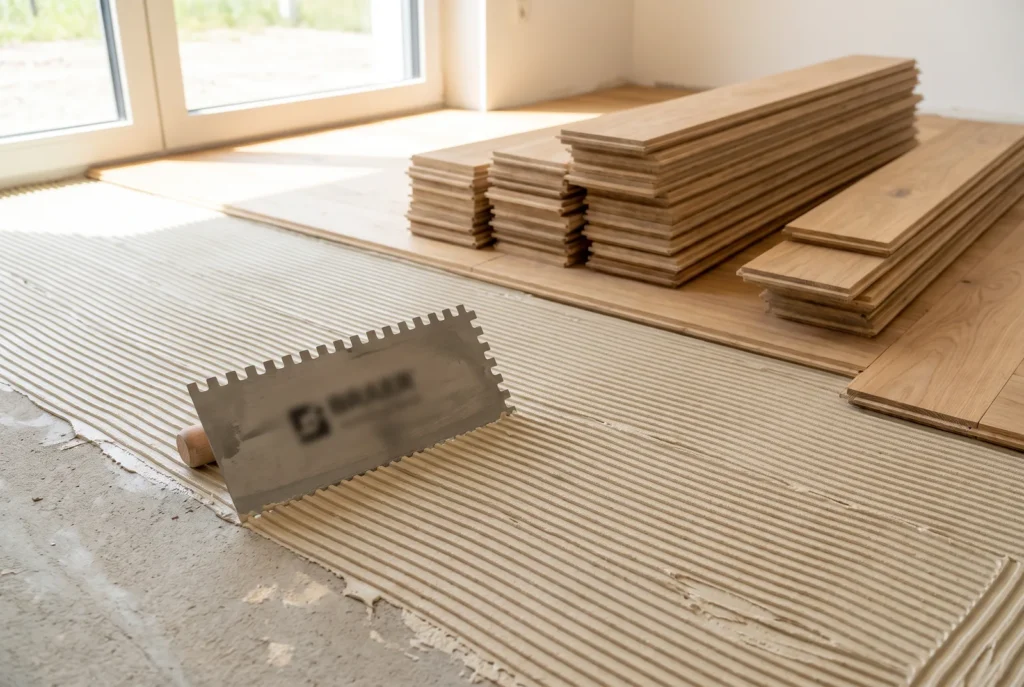
The installation method changes more than the choice of floor itself: the sound the floor makes underfoot, its lifespan, whether you can ever lift it. Here are the three families, with their real advantages and their real limits.
Floating installation
The boards click together and rest freely on an underlay, with no fixing to the subfloor. It is the most widespread method in renovation.
In favour:
- Fast, and doable yourself.
- No adhesive, so it can be taken up and moved.
- Lays over existing tiles without removing them.
- The cheapest to install.
Against:
- The sound. This is its main flaw. A board resting on an underlay acts as a sounding box: footsteps resonate, you hear a faint knock. A good underlay reduces it; it does not remove it.
- Less firm underfoot, sometimes a slight give.
- Maximum area limited without an expansion break, generally around 8 metres in one direction.
- Engineered boards only — a solid board cannot be laid floating.
Glued installation
The floor is fully bonded to the subfloor with a suitable adhesive, usually an MS polymer. It is the reference method.
In favour:
- Silence. No sounding-box effect, the sound is dull, the floor feels solid. It is the most immediately noticeable difference from a floating floor.
- The only method genuinely recommended with underfloor heating: direct contact optimises heat transfer.
- Mandatory in wet rooms and over large areas without breaks.
- Longer lifespan: no play developing in the click joints over time.
Against:
- The subfloor must be flat, dry and clean. Flatness required is 5 mm under a 2 m straightedge, and residual moisture in a cement screed must be down below 2.5%.
- Irreversible in practice — lifting it destroys the boards.
- Higher cost for labour and adhesive.
- A professional job in most cases.
Nailed installation
The traditional method: boards nailed onto battens or joists. It concerns thick solid floors.
In favour:
- The historic method, the one behind floors still standing after a century.
- The void beneath allows services to run and insulation to be fitted.
- Copes with uneven subfloors thanks to adjustable battens.
Against:
- Raises the floor by several centimetres — door height becomes an issue.
- Incompatible with underfloor heating.
- Thick solid boards only.
- The most expensive in labour.
The decision table
| Your situation | Recommended |
|---|---|
| Underfloor heating | Glued |
| Kitchen, bathroom | Glued |
| Flat, neighbours below | Glued (or floating with a very good underlay) |
| Large unbroken area | Glued |
| Fast renovation, tight budget | Floating |
| Rental, floor to hand back as found | Floating |
| Thick solid boards, period house | Nailed |
The question we get asked most
“Is gluing really worth the extra?” On the sound, yes, frankly. Many people who lay floating are happy with the look and disappointed by the noise — and by then it is too late. If the budget allows and the subfloor is suitable, gluing is the choice people rarely regret.