


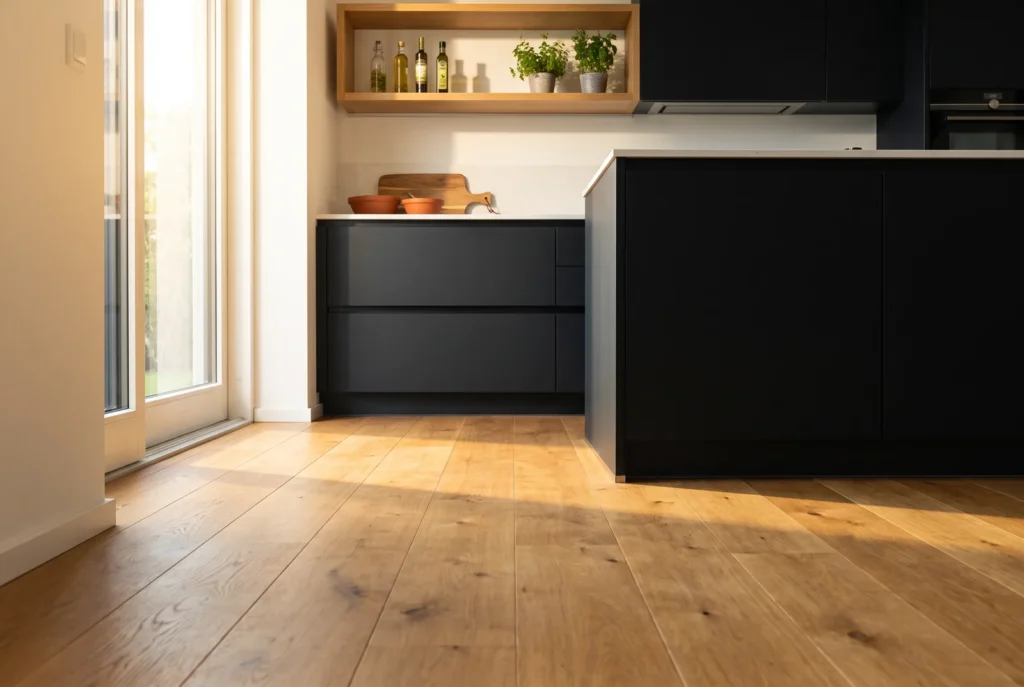
The open-plan kitchen has settled the debate for many people: when kitchen and living room are one space, laying tiles on one side and wood on the other cuts the volume in two. What remains is whether wood holds up. It does — but not just any wood.
The real risks, in order
Unlike a bathroom, ambient humidity is not the main problem in a kitchen. The damage comes from elsewhere:
- Stains. Oil, wine, beetroot, curry. On a porous, poorly maintained finish, an olive-oil stain left overnight can mark permanently.
- Impacts. A cast-iron pan falling off a worktop leaves a clean dent. It is the most common mark in a kitchen.
- Localised traffic. The square metre in front of the sink and the oven takes ten times more footfall than the rest of the room. That is where wear appears first.
- The undetected leak. Dishwasher, fridge water line. It is the only risk that can destroy an entire floor.
What matters: the finish
The choice of finish weighs more than the species or the format.
- Lacquer — the surface film blocks liquids. A wine stain wipes off without a trace. It is the calmest choice in a kitchen, especially with children.
- Oil — more beautiful, deeper, and repairable in one spot: that is its big advantage when a pan has dented the floor. But it demands real upkeep, and a greasy stain must be dealt with quickly.
Grade matters too
A rustic grade, with its knots and variation, forgives far more than a perfectly uniform Prime grade. A small mark blends into the irregularities of the wood instead of jumping out at you. For a family kitchen, that is a serious argument.
The precautions that genuinely help
- A drip tray under the dishwasher. A few euros, and the only protection against the disaster scenario. Same for the fridge water line.
- A washable mat in front of the sink. It absorbs the repeated splashes exactly where they land.
- Felt pads under the chairs, especially if the table is in the kitchen. Chair scratches do more damage than the cooking does.
- Wipe fast. No complicated rule: what falls gets wiped within the hour, and nothing happens.
The useless precautions
Two received ideas you can drop:
- “Oven heat damages the floor.” No. A correctly built-in, ventilated oven does not heat the floor significantly.
- “Cooking steam swells the wood.” Not that either, as long as an extractor hood works. The steam from a pan of pasta has nothing to do with bathroom humidity.
And the installation?
Gluing down is preferable in a kitchen, for the same reason as in a bathroom: if water gets in, it does not spread under the whole surface. It also gives a more solid floor underfoot and a duller sound.
The verdict
Wood in the kitchen, yes — with an engineered board, a suitable finish, a forgiving grade and a tray under the dishwasher. What kills a kitchen floor is almost never the cooking: it is a leak nobody noticed for three weeks.