


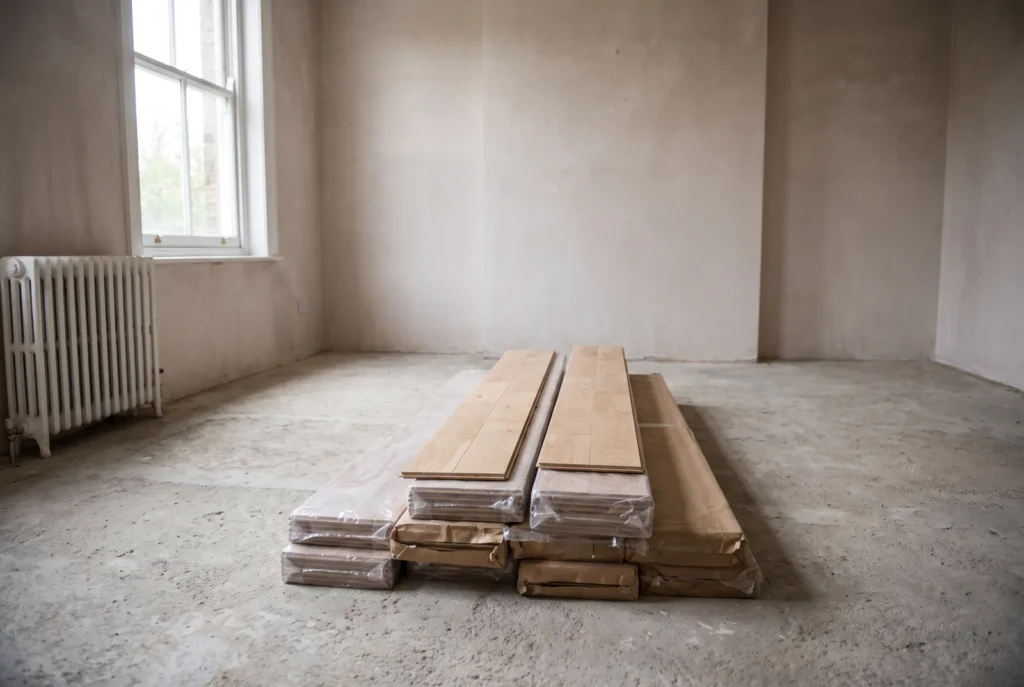
A floor that opens up in winter or cups in spring is almost never a bad floor. It is a floor laid too soon. Acclimatisation is the step everyone knows about and many cut short — it is the leading cause of failure on a timber floor.
Why it is necessary
Wood is hygroscopic: it constantly exchanges moisture with the surrounding air until it reaches equilibrium. When it absorbs, it swells; when it dries, it shrinks. And those movements happen mainly across the width, very little along the length.
A floor made and stored in a warehouse at 60% relative humidity, delivered into a new build at 75% or a heated house at 35%, will move. Lay it before it has finished moving and it carries on once nailed, glued or clicked — and then something has to give.
What that looks like in practice
- Laid too damp, the floor then dries and shrinks: open gaps appear between boards, sometimes several millimetres.
- Laid too dry, it absorbs and swells: it pushes against the walls, and having nowhere to go, it lifts. That is cupping.
In both cases nothing can be put right without lifting the floor.
The conditions to meet
Acclimatisation is not leaving packs in a garage. Four conditions must be met:
- The flooring inside the room where it will be laid, not in the hallway or the basement.
- The home in normal working order: heating on if it is winter, windows shut, ventilation running.
- All wet trades finished and dry: screed, plaster, paint, levelling compound. Drying plaster releases an enormous amount of water into the air.
- Packs laid flat, raised a few centimetres, never standing against a wall.
Should the packs be opened?
This is where opinions diverge. The rule that works:
- Engineered board — leave the packs closed. Engineered is stable by construction, and the packaging protects it from a sudden humidity shock. It is also what most manufacturers specify.
- Solid board — packs may be opened, and the boards even spaced out, for faster and more even acclimatisation.
In every case, follow the product instructions: they override any general rule.
How long?
| Situation | Duration |
|---|---|
| Engineered, occupied and stable home | 48 to 72 h |
| Engineered, new build or recent renovation | 5 to 7 days |
| Solid | 7 to 15 days |
| Wide solid boards or damp property | up to 3 weeks |
These durations assume correct conditions. In a house that has just been plastered, two weeks will not be enough.
The values to aim for
At the moment of laying, you want:
- Room temperature: 18 to 22 °C.
- Relative humidity: 45 to 65%.
- Moisture content of the wood: around 9%, plus or minus 2 points.
- Residual moisture in the screed: below 2.5% for a cement screed, below 0.5% for anhydrite. These thresholds drop further with underfloor heating.
A hygrometer costs about fifteen euros. It is the most profitable purchase of the whole job.
The underfloor heating case
An extra procedure applies: the screed's commissioning heating cycle must be carried out and documented before laying, then the heating switched off or turned down during acclimatisation and installation, and brought back up gradually afterwards.
The most frequent mistake
Laying in a new house “because the tiler is coming next week”. A newly built home holds tens of litres of water in its walls and slab. Flooring is the last trade on site, never the second to last.
We deliver throughout Europe in 2 to 10 days: order ahead, but keep the acclimatisation period before you lay.