

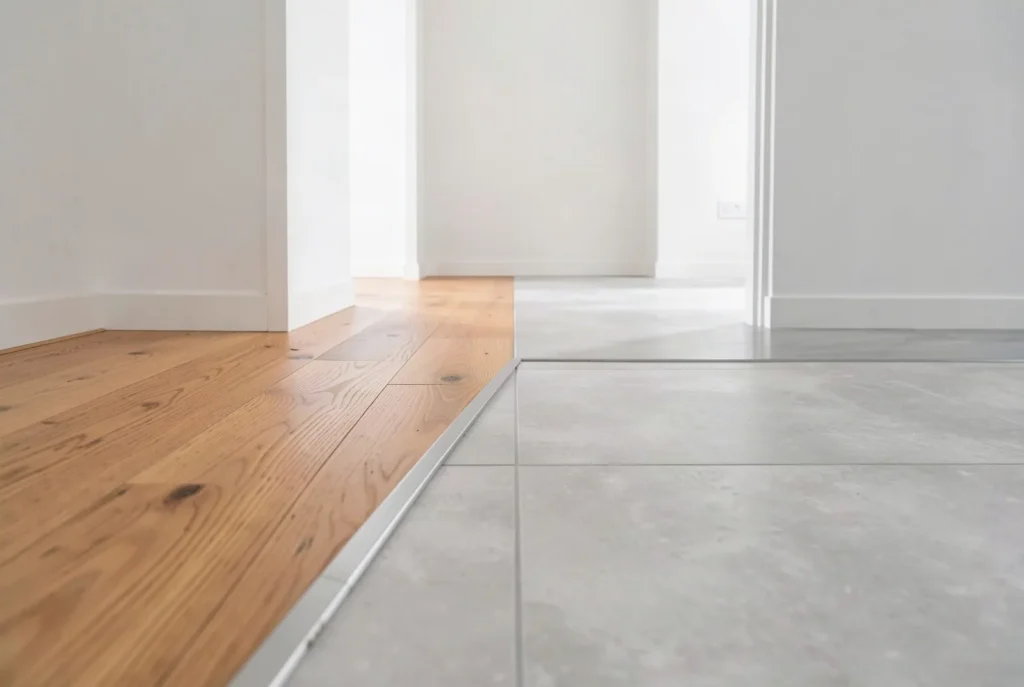
The short answer: tiles win in wet rooms and wherever the floor takes water or heavy impacts; wood wins everywhere else, on comfort, perceived warmth, acoustics and the value of the property. In a home, the most common and most rational split is tiles in the bathroom, wood in the rest.
The comparison in one table
| Criterion | Oak flooring | Tiles |
|---|---|---|
| Comfort barefoot | Warm, temperate | Cold without underfloor heating |
| Acoustics | Damps sound, especially glued | Reverberant, hard surface |
| Water resistance | Limited, needs care | Excellent |
| Impact | Marks, but repairable | Very good, but a cracked tile is hard to replace |
| Refinishing | Sandable, several times | None, full removal |
| Lifespan | 30 to 100 years by thickness | Very long if left in place |
| Supply price | from €22.80/m² incl. VAT | Very variable by range |
Comfort: the clearest gap
This is what you feel every day. Wood has low thermal conductivity: it draws heat from the foot only slowly, giving a sense of warmth even at the same room temperature. Tiles carry heat away fast — hence the cold impression, which is not a matter of temperature but of transfer speed. Underfloor heating erases that difference, and it is the main argument for tiles in new build. Note that wood is perfectly compatible with underfloor heating too, provided the thickness and installation are right — see wood over underfloor heating.
The second gap, often underestimated, is acoustic. A fully tiled home echoes: conversations, footsteps and television all reverberate. Wood damps naturally. In a flat this also matters to the neighbours below — see flats and shared buildings.
Upkeep: closer than it looks
Tiles pass for indestructible and maintenance-free. True of the tile itself, much less of its grout, which stains, hollows and yellows, and is tedious to clean. Wood needs regular but light care, and in return it can be renovated: surface wear disappears under sanding, which no tile allows. See caring for an oiled floor and caring for a lacquered floor.
Room by room
- Bathroom: tiles by default. Wood is possible with the right species and finish — see wood in the bathroom.
- Kitchen: both work; wood increasingly wins in open kitchens, for continuity with the living room — see wood in the kitchen.
- Living room, bedrooms, hallways: wood, without hesitation.
- Utility room, garage, cellar: tiles or a technical floor.
Price: what are you comparing?
Both families cover such wide ranges that a raw comparison is meaningless. What is comparable is the complete cost: supply, subfloor preparation, installation and lifespan. Tiling usually costs more to lay than a floating wood floor. Conversely, a quality wood floor often exceeds an entry-level tile in supply. Our engineered oak runs from €22.80 to over €100/m² incl. VAT — see our price guide and how long a wood floor lasts.
Frequently asked questions
Can wood go over existing tiles?
Yes, very often, and it is the most economical route in a renovation. See laying over tiles.
Is wood a good choice with children or a dog?
Yes, with a marked grade and a repairable finish. Unlike carpet it traps neither mites nor dust. See hardness, scratches and pets.
What about laminate or vinyl?
They are imitations — cheaper, often very hard-wearing, but not renewable and without the value of real wood. See wood, laminate or vinyl.