

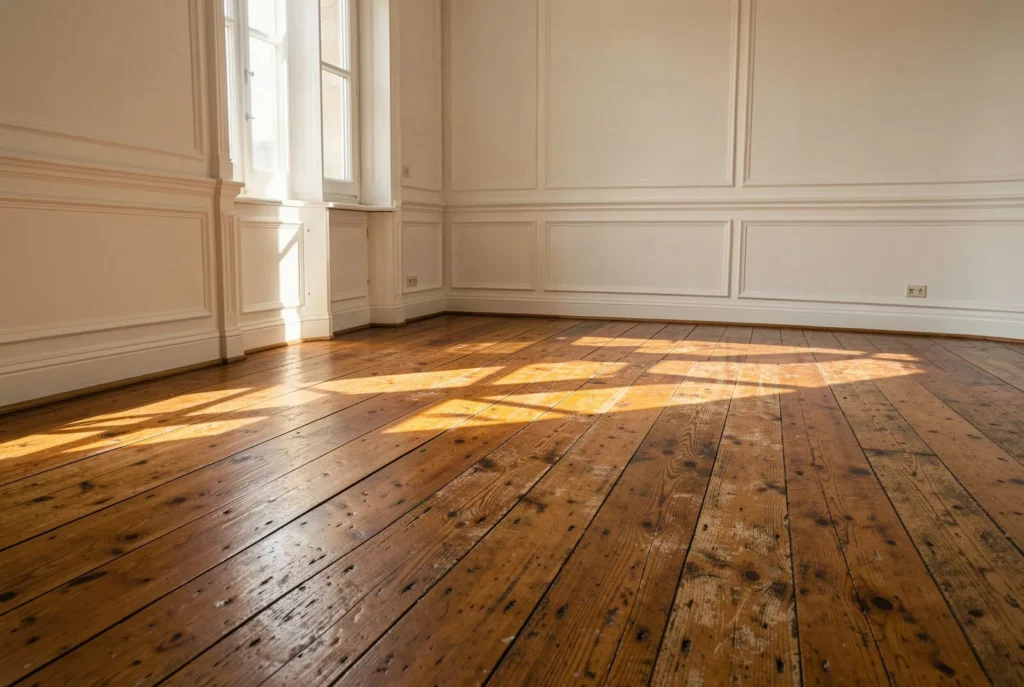
The short answer: engineered oak with a 3 mm wear layer lasts 30 to 40 years in a normal home; with 4 mm or more it comfortably passes 50. A 20 mm solid floor can cross a century. It is not the purchase price that decides, but the thickness of noble wood available for future sanding.
What actually wears out?
Contrary to a widespread intuition, the wood is almost never the first thing to go. Three distinct mechanisms follow one another: the finish wears first — lacquer dulls and scratches on traffic lanes, oil washes out; this is a surface phenomenon and entirely reversible. The wood wears very slowly, and only becomes significant after several decades or several sandings. And accidents — a leak, a major impact, a moisture problem — are what genuinely cut a floor's life short, not footfall.
In other words, a floor that has “aged badly” usually has a tired finish on intact wood. A surface renovation gives it another ten or twenty years.
How many sandings?
This is the question that decides everything. A full sanding removes roughly 0.5 to 1 mm, and at least 2 mm of wood must remain above the tongue on an engineered board.
| Type | Wear layer | Full sandings | Indicative lifespan |
|---|---|---|---|
| Thin engineered | 0.6–2 mm | 0 to 1 (light refresh) | 15–25 years |
| Standard engineered | 2.5–3 mm | 1 to 2 | 30–40 years |
| Thick engineered | 4 mm | 2 to 3 | 40–60 years |
| Premium engineered | 6 mm | 3 to 4 | 60 years and beyond |
| Solid | 15–20 mm usable | 6 to 10 | 80–100 years and more |
See the wear layer explained and choosing thickness.
How often to renovate?
Three levels, and this is where owners often sand too early. Routine care: regular cleaning, and for an oiled floor a maintenance oil every one to three years — it consumes no material and extends the finish indefinitely. Surface renovation: a very light abrasion then a fresh finish, every 10 to 15 years depending on use. Full sanding: reserved for real damage — deeply marked wood, stains, a change of tone. Only this last one eats into the wear layer. See sanding and refinishing and caring for an oiled floor.
What shortens a floor's life?
- Uncontrolled humidity — the number one killer, far ahead of wear. Aim for 45–65 % relative humidity. See humidity and wood floors.
- Insufficient expansion gaps, causing lifting and unclipping. See expansion gaps.
- Grit carried in on shoes — the main source of micro-scratches. A doormat is the most cost-effective measure that exists.
- Furniture without felt pads, dining chairs above all.
- A badly prepared subfloor, which condemns the joints from day one. See levelling and flatness.
Frequently asked questions
Can a floor from 1900 still be renovated?
Often yes, and that is what makes old floors valuable. A century-old 22 mm solid oak floor frequently has several sandings left. See renovate or replace.
Does underfloor heating shorten the life?
No, if it is properly controlled and the floor is glued. It is temperature swings and over-dry air that tire the wood, not the principle of heating from below.
How do I know how much wear layer is left?
Find a discreet spot — under a lifted skirting, at a pipe cut-out — and measure the wood above the tongue. Failing that, the original product documentation gives the figure.