

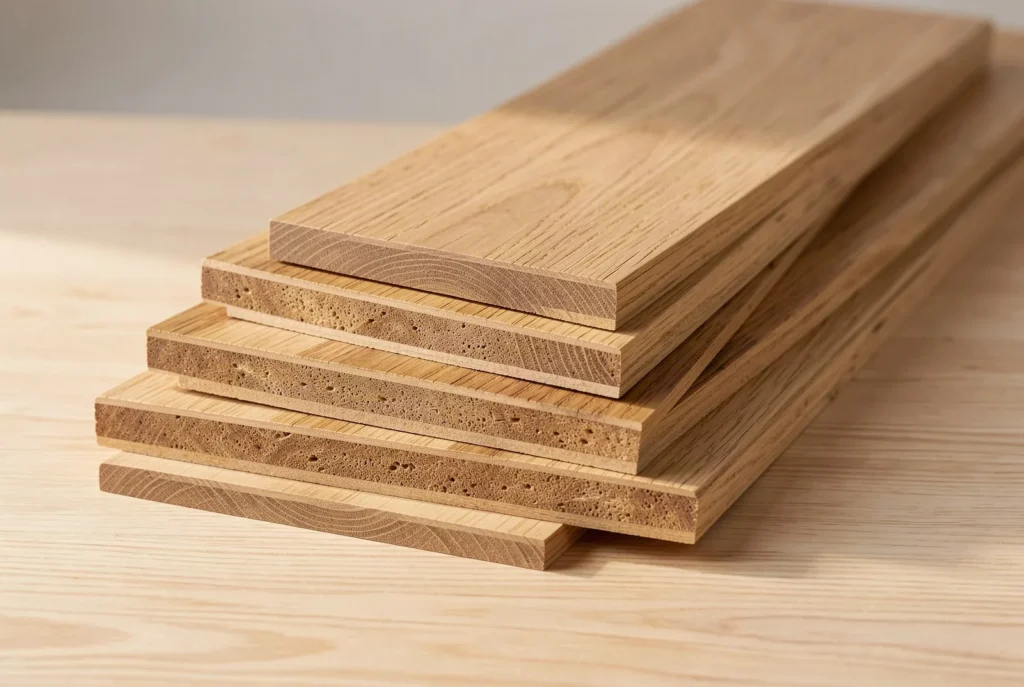
The short answer: for a normal home, engineered oak 14 mm thick with a 3 mm wear layer covers almost every situation, glued or floating. Drop to 10–11 mm when height is tight or over underfloor heating; go up to 15–20 mm if you want to sand the floor several times over its life.
Overall thickness or wear layer?
This is the costly confusion. Two numbers coexist on an engineered board: the overall thickness (10, 14, 15, 20 mm), which sets the height taken, the rigidity and the thermal resistance; and the wear layer (0.6 to 6 mm), the noble oak on top, which alone decides how many times the floor can be sanded.
A 14 mm board with 0.6 mm of oak and a 14 mm board with 4 mm have nothing in common in lifespan, yet both read as “14 mm”. Trade notation separates them: 15/4 means 15 mm total including 4 mm of oak. See the wear layer explained.
Which thickness for which use?
| Overall | Typical wear layer | Installation | Best for |
|---|---|---|---|
| 7–8 mm (mosaic) | solid throughout | Glued only | Chequerboards, low build-up renovation |
| 10–11 mm | 2–2.5 mm | Glued or floating | Renovation, underfloor heating, tight height |
| 14 mm | 3 mm | Glued or floating | The all-round standard |
| 15–16 mm | 4 mm | Glued or floating | Heavy use, future refinishing |
| 20–21 mm | 6 mm or solid | Glued or nailed | Premium, heritage, very long life |
A thickness filter on the shop lets you sort the references in stock.
Why thinner over underfloor heating?
Wood insulates. The thicker it is, the more it slows heat transfer and the harder the system must work. The accepted rule is that the covering plus adhesive should stay below 0.15 m².K/W, which points to 10–14 mm fully bonded. Gluing beats floating here: continuous contact means far better diffusion. See wood flooring over underfloor heating.
What about renovation height?
Thickness stops being an aesthetic choice and becomes a constraint. Add the underlay (1–3 mm floating) or adhesive bed (about 1 mm), plus any levelling compound, then check door clearance, thresholds and the bottom stair nosing. See stairs and nosings and levelling and flatness.
Frequently asked questions
Is a thicker floor more scratch-resistant?
No. Scratch resistance comes from the surface finish and the hardness of the species, not from thickness. See hardness and scratches.
Can 10 mm be laid floating over a large area?
Possible but not advisable beyond a few dozen square metres, especially in wide boards: low rigidity encourages noise and a springy feel. Glue instead.
How do I find the exact thickness of a reference?
It appears on each product card and detail page as “15/4 mm” (overall / wear layer). If in doubt, write to us.