


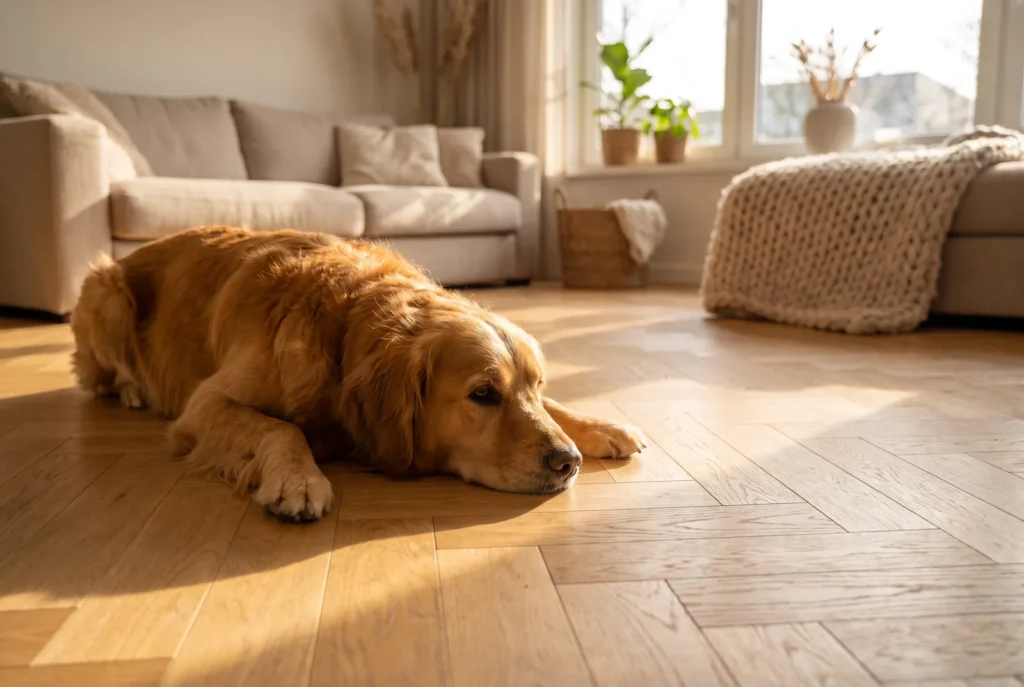
“I have a dog, I can't have a wooden floor.” That is wrong, but the question deserves better than a flat denial. Here is what really marks a floor, in order of importance — and the choices that genuinely make a difference.
The real culprit: grit
What wears a floor is not weight and it is not claws. It is the mineral micro-particles — sand, grit, abrasive dust — trapped under shoe soles and dragged across the finish. They act as sandpaper at every step.
Direct consequence: an effective doormat at every entrance protects your floor more than any choice of species. A real doormat, big enough for three steps, scrapes the soles before they reach the wood.
Dog claws: the reality
Claws do mark, but rarely as people imagine. They are not deep gouges: they are superficial micro-scratches in the finish, concentrated where the animal starts and brakes — in front of the door, at the foot of the sofa, in corridors.
Three useful facts:
- A dog running on a wooden floor makes far more marks than a dog walking. Take-off zones account for 80% of scratching.
- Regularly trimmed claws markedly reduce the phenomenon. It is the single most effective habit.
- Scratches accumulate slowly and mostly show under raking light.
Stiletto heels do not scratch: they punch. A thin heel concentrates the whole body weight on a few square millimetres and leaves a round dent. That is deformation of the wood, not damage to the finish — and it concerns every timber, even the hardest.
Hardness of the wood: useful, but secondary
Hardness is measured by the Brinell test, to EN 1534. A few benchmarks:
| Species | Relative hardness |
|---|---|
| Oak (European or American) | Good — the flooring benchmark |
| Walnut | Slightly below oak |
| Ash | Comparable to oak, sometimes a little above |
| Pine, spruce | Considerably softer |
Moving from oak to a very hard tropical timber improves resistance to denting. It changes almost nothing about superficial scratching, which happens in the finish, not in the wood.
The three choices that really count
1. The finish
This is factor number one.
- Lacquer — the film resists abrasion well. But once scratched, local repair is difficult: you have to sand and re-lacquer a whole area.
- Oil — scratches slightly more easily, but repairs locally. A pad and some maintenance oil on the marked area, and the trace disappears. With a pet, that repairability is a decisive argument.
2. Grade and surface
A brushed floor and a rustic grade forgive infinitely better than a smooth, uniform Prime. The relief of the brushing and the irregularities of the wood visually absorb marks. It is the most underrated piece of advice: with animals, the choice of grade matters more than the choice of species.
3. The tone
A mid-tone wood — natural oak, honey — hides far better than a very pale or very dark floor. On a whitened oak, every dark hair shows; on a dark fumed oak, the least dust stands out.
The habits that change everything
- A doormat at every entrance, large enough.
- Felt pads under all furniture, replaced when they get dirty — a pad full of grit scratches more than a bare foot.
- Regular vacuuming, brush raised, to remove the grit before it does its work.
- Trimmed claws.
- A rug in the animal's take-off zones.
What you have to accept
A wooden floor lives. It takes on a patina, it keeps traces, and that is precisely what distinguishes it from a synthetic floor that stays perfectly smooth for life. If the idea of a single mark is unbearable, a laminate or a vinyl will suit you better. If you accept that a floor tells the story of the house, wood will last twenty years and can then be renovated.