


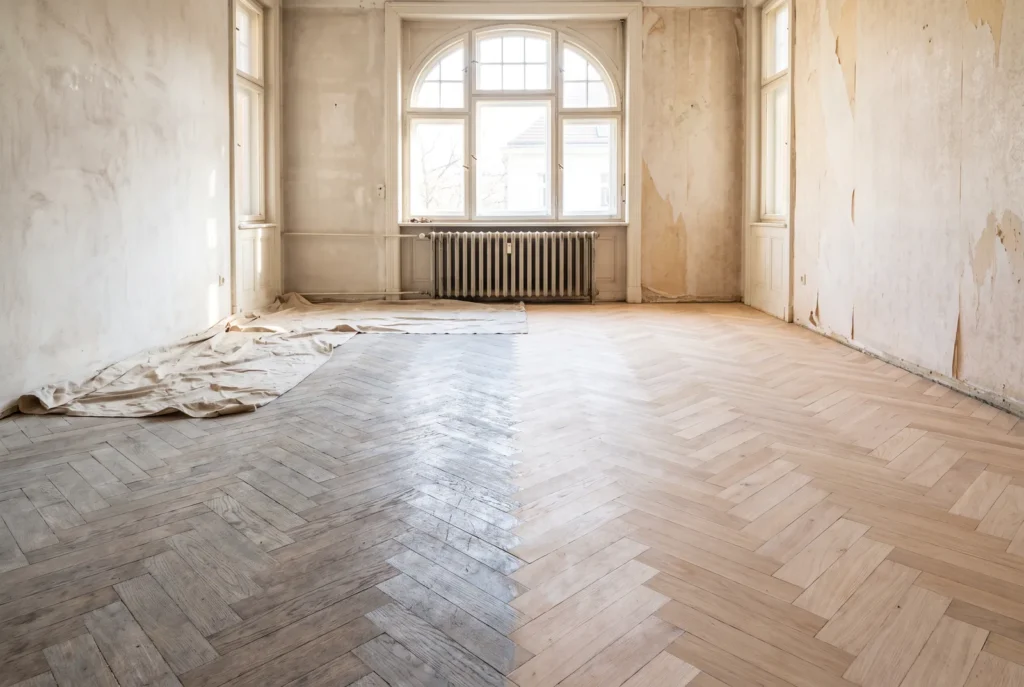
You inherit an old floor: dark, scratched, perhaps under carpet for thirty years. Should you save it or start again? Three checks settle it, and they take an hour.
Check 1: how much thickness is left?
This is the point that decides everything. A sanding removes between 0.5 and 1.5 mm of wood. So the question is: is there enough material left above the fixings?
How to find out: take off a skirting board in a corner, or lift a board near a threshold. You will see the real thickness and the type of floor.
- Old solid floor (22 mm nailed to joists) — there is almost always margin left. These floors have often been sanded two or three times and still take another pass. The most favourable case.
- Mosaic or thin strip parquet glued down (8 to 10 mm) — one or two sandings maximum in its whole life. If it has already been renovated, that is the end.
- Engineered — it all depends on the wear layer. If nail heads or the substrate core appear, there is nothing left to sand.
The stop signal: if nail heads are already flush, or if the pale wood of the substrate shows in places, sanding is out of the question.
Check 2: is the substrate sound?
A beautiful floor over a sick structure cannot be renovated. Check:
- Boards that move or creak loudly — often nails that have let go, repairable. But general sagging signals a joist problem.
- Traces of damp — tide marks, blackened boards, a cellar smell. The cause must be dealt with first, otherwise the problem returns.
- Insect attack — small round holes with fine sawdust. Active infestation: treatment is mandatory, and sometimes replacement of the affected pieces.
- Cupping — hollowed or domed boards can be corrected by sanding if the defect is slight, not if it exceeds a few millimetres.
Check 3: do you actually like it?
A trivial but decisive question. Sanding changes the tone and the finish; it changes neither the board format, nor the laying pattern, nor the species.
If your floor is 6 cm strip parquet and you were dreaming of wide planks, no amount of sanding will give you them. If you wanted a chevron, you will have to replace.
The decision table
| Situation | Decision |
|---|---|
| Thick old solid floor, sound, format you like | Renovate — the best result/price ratio |
| Thin strip parquet already sanded several times | Replace |
| Untreated damp, sagging joists | Treat first, decide afterwards |
| Sound floor but unwanted format or pattern | Replace — renovation will change nothing |
| Underfloor heating project | Replace |
What each option costs
A full renovation — sanding, denibbing, finishing — generally comes out considerably cheaper than replacement including supply and installation. It is also faster, with no removal of skirtings or doors.
But beware the false economy: renovating a floor that has only one sanding left merely postpones replacement by a few years. If the wood is at the end of its life, better to invest directly in a floor that will last twenty years.
The middle path
It is often forgotten: laying a new engineered floor over the old one, floating, provided it is flat and sound. That avoids the removal — the messiest and most expensive item — and the old floor acts as the substrate. The only constraint is the height gained, to be checked at doors and thresholds.
A 14 mm engineered board with its underlay adds around 16 mm.
In doubt
Take off a skirting board, photograph the edge of the floor with a ruler beside it, and send us the picture. We will tell you what we see — and if the answer is “your floor is excellent, keep it”, we will say that too.