


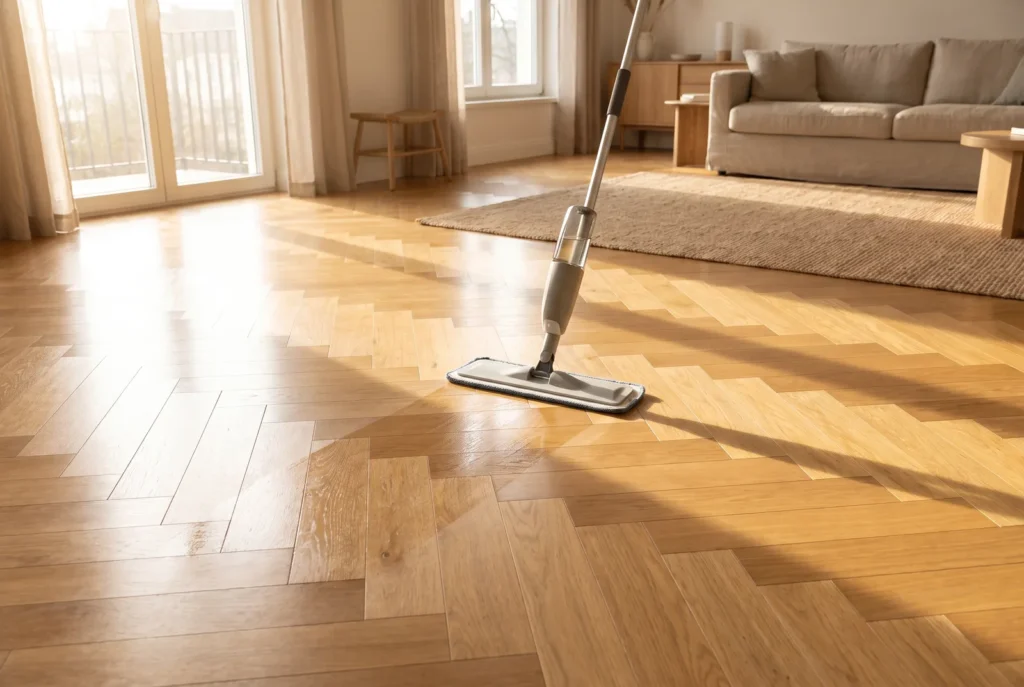
A lacquered floor asks for little, but it asks for the right gesture. Many lacquers die early because of an unsuitable cleaning product or a mop that is far too wet. Here is what preserves a lacquer, and what ruins it.
What you are maintaining is not the wood
This is the fundamental difference with an oiled floor. Lacquering lays a continuous film — usually polyurethane — over the surface of the wood. That film takes the wear, the scratches and the liquids. The timber underneath never comes into contact with anything.
The consequence: you do not maintain the wood, you maintain the film. And a film is not fed, it is protected. That is the exact opposite of the logic of an oiled floor.
Routine cleaning
- Vacuum first, brush raised or with a floor head. Sand and grit are what wear a lacquer; sweeping them up before anything damp goes down stops you dragging them across the whole surface.
- A well wrung-out mop, never a wet one. The test: the floor should dry in under a minute. If you can see water sitting in a joint, your mop is too loaded.
- A neutral cleaner made for lacquered floors, heavily diluted. Or simply clean water, which is enough in most cases.
How often? Once a week in a living room, less in a bedroom. A lacquer does not need washing every day.
What kills a lacquer
| Never use | Why |
|---|---|
| A steam cleaner | Pressurised steam passes through the joints and lifts the lacquer from underneath. The most destructive mistake there is, and it cannot be undone. |
| Ammonia-based products | They chemically attack polyurethane and dull it permanently. |
| Bleach | Discolours the lacquer, and the wood if it gets through. |
| Acidic or stripping cleaners | Neat white vinegar included, contrary to what you read everywhere. |
| Waxes and oils | They cannot penetrate the film: they sit on top, make it slippery and trap dirt. |
| Abrasive pads | They scratch deep into the film. |
Common stains
On a lacquer in good condition almost everything comes off with warm water if you act quickly. For stubborn cases:
- Black scuff marks from soles — a white eraser or a barely damp microfibre cloth.
- Ink, marker — surgical spirit on cotton wool, dabbing, never rubbing.
- Grease — warm water with a drop of washing-up liquid.
- A white bloom under a plant pot — that is moisture trapped inside the film. It sometimes fades as it dries; otherwise only a local re-coat will remove it.
The habit that extends everything
Felt pads under every piece of furniture, checked once a year. A pad clogged with grit does more damage than no pad at all. And a proper doormat at every entrance.
When does the lacquer need redoing?
A quality factory lacquer lasts between 10 and 20 years in a home. The signs that it is time:
- Matt patches appear in the traffic areas while the rest still shines.
- The wood drinks water when you put a drop down: the film is breached.
- Fine white scratches cover the surface evenly.
Two options then:
- Renovation without sanding — a very light key sanding then a new coat. Only possible if the film is worn but not breached.
- A full sanding — everything is taken back to bare wood and re-lacquered. That consumes material: check the available wear layer first.
Lacquered or oiled: the real trade-off
Lacquer asks less of you day to day, but its repair is all or nothing: you cannot fix one area without the patch showing. Oil asks more attention but repairs locally.