


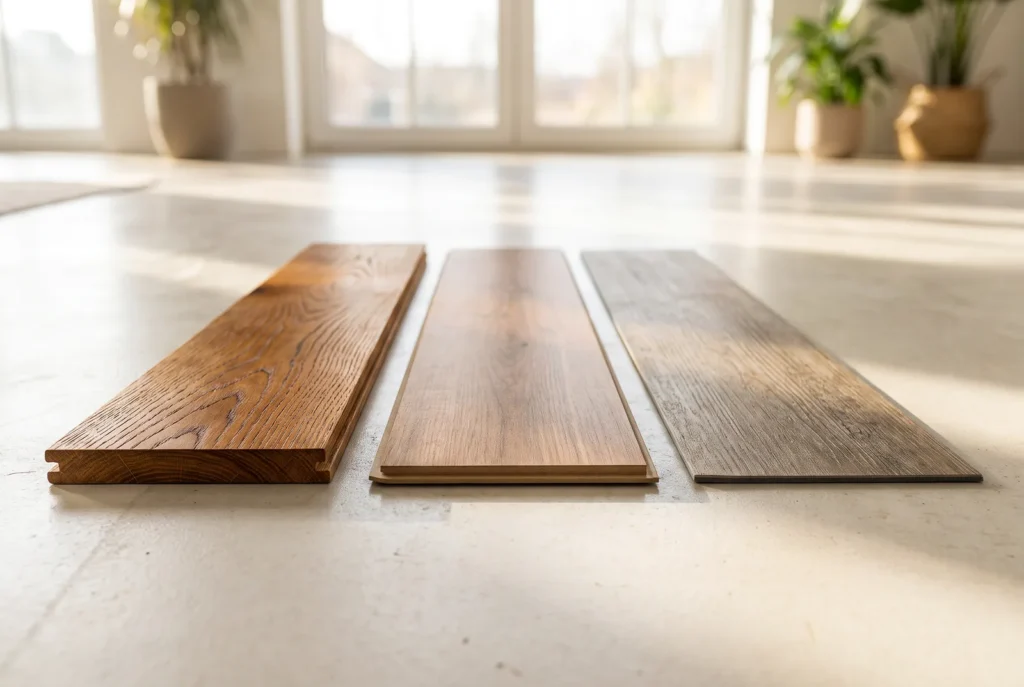
They sit side by side in the same aisle, with photographs that look alike. Yet one is wood, another is a printed image under a film, the third is plastic. Here is the honest comparison, without pushing you towards any of them.
What each one actually is
- Wood flooring — solid timber on the surface. EN 13489 for engineered, EN 13226 for solid. The visible layer is oak, walnut, ash. It can be sanded and refinished.
- Laminate — a high-density fibreboard (HDF) panel topped with a printed decor paper and a melamine film. No wood at the surface. EN 13329.
- Vinyl (LVT/SPC) — PVC, often on a rigid mineral core, with a printed decor and a transparent wear layer. EN ISO 10582.
That difference in nature explains everything else.
Point by point
| Wood | Laminate | Vinyl | |
|---|---|---|---|
| Surface | Real timber | Printed decor | Printed decor |
| Renewable by sanding | Yes (2.5 mm = once, 6 mm = 4-5 times) | No | No |
| Realistic lifespan | 30 to 100 years | 10 to 20 years | 15 to 25 years |
| Water resistance | Moderate to good depending on finish and installation | Poor (the HDF swells) | Excellent |
| Visible scratches | Yes, but repairable | Few, but irreparable | Few, but irreparable |
| Feel underfoot | Warm, dense | Hard, noisy | Soft, slightly cold |
| Underfloor heating | Yes, engineered and glued | Yes | Yes |
| Purchase price per m² | The highest | The lowest | In between |
The real criterion: what does it become in ten years?
This is where the comparison tips, and it is what product pages never say.
Laminate and vinyl age by wearing away: the printed layer dulls in the traffic areas, and once it is breached you see the substrate. There is no repair. The floor is replaced entirely.
Wood ages by gaining a patina. It picks up marks, it darkens or lightens depending on the species, and after fifteen or twenty years a sanding restores it for a fraction of the cost of replacement.
So the cost that matters is not the price per square metre, it is the price per year of use.
Where each one is the right answer
- Vinyl wins in a bathroom with a walk-in shower, a utility room, a damp basement. Where wood will not last, there is no point insisting.
- Laminate wins on a tight budget and a short horizon: a rental to freshen up, a teenager's bedroom, a room that will be redone in eight years.
- Wood wins everywhere else, and above all in the living spaces you keep: living room, bedroom, hallway, corridor. It is the only one of the three that gains value with time rather than losing it.
Two received ideas to correct
“Laminate imitates so well you cannot tell the difference.” At a metre away, often true. On the floor, in raking morning light, never: a printed decor repeats every six to eight boards, real wood does not repeat. And touch gives it away immediately.
“Wood is fragile.” An oak at 700 kg/m³ is not fragile. It marks, which is not the same thing — and those marks can be repaired, which is precisely the opposite of fragility.
Our position, honestly
We sell wood flooring, so our view is not neutral and you should know that. What we can say without a conflict of interest: if water runs across your floor, choose vinyl. If your horizon is under ten years, laminate is rational. In every other case, compare the price against the lifespan, not the price on the label.