


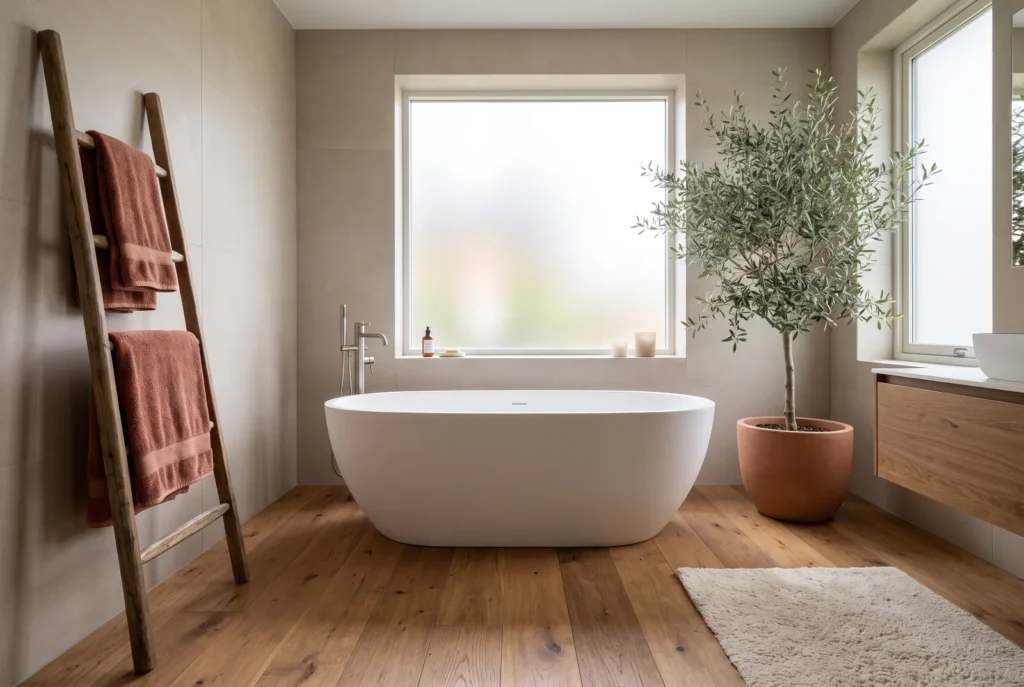
The short answer is yes. The useful answer comes down to five conditions, and if one is missing the floor will not last. Here is what separates a successful wooden bathroom from a floor that cups after two winters.
What actually damages a floor in a bathroom
Contrary to what people imagine, it is not the occasional splash. A puddle wiped up within the hour does nothing to a properly finished floor. The two real enemies are:
- Airborne humidity, continuously. A poorly ventilated bathroom stays at 70–80% relative humidity for hours after a shower. The wood absorbs, swells, and when it dries it does not return to exactly the same shape.
- Water standing in the joints. That is how it gets under the wear layer and lifts the floor from below.
Condition 1: engineered, not solid
Solid boards move across their width with humidity — that is their nature. In a room where humidity swings hard, they cup or they open up. An engineered board, with its cross-laminated layers, absorbs those swings far better. It is the default choice for a bathroom.
Condition 2: a closed finish
This is the most important point. Two options hold up:
- A polyurethane lacquer — it forms a continuous film that stops water penetrating. The most protective. In exchange, a deep scratch goes through the film and repairs badly in one spot.
- A quality hardwax oil — it does not form a film but saturates the wood in depth and makes it water-repellent. It repairs locally, which is a real advantage. It does require closer upkeep.
What will not hold up: an unfinished raw board, or a light oiled finish meant for a bedroom.
Condition 3: extraction that works
This is not negotiable. Without effective air extraction, no wooden floor survives long-term in a bathroom. Check that your extract vent really pulls — the sheet-of-paper test, where the paper should stay stuck to the grille, is enough. A window opened for ten minutes after a shower does not replace mechanical extraction in winter.
The target: back below 60% relative humidity within the hour after a shower.
Condition 4: glued down
With a floating floor, water that gets past a joint spreads under the whole surface and has no way to dry. Fully bonded, the adhesive acts as a barrier and the boards do not move. It is the only method we recommend in a wet room.
Condition 5: perimeter joints treated
The perimeter expansion gap is mandatory — but in a bathroom it must be filled with a flexible sealant before the skirtings go on, not simply left empty. Same at the foot of the shower, the bath and around the basin pedestal. That few-euro detail prevents most claims.
What we will not make work
Let us be clear about the limits: in a walk-in shower with no tray, where water runs directly onto the floor, no wooden flooring is suitable. Wood accepts humid air and splashes, not running water. Plan tiles or resin in the shower zone, and wood over the rest.
Which species
Teak and oily tropical timbers are the traditional answer. In practice, a properly finished and properly laid engineered oak holds up perfectly in a ventilated family bathroom, and that is what gets installed most often today. Walnut, being softer, is less suitable.
The one-line summary
Engineered + closed finish + working extraction + glued down + sealed joints. All five together, or none.