

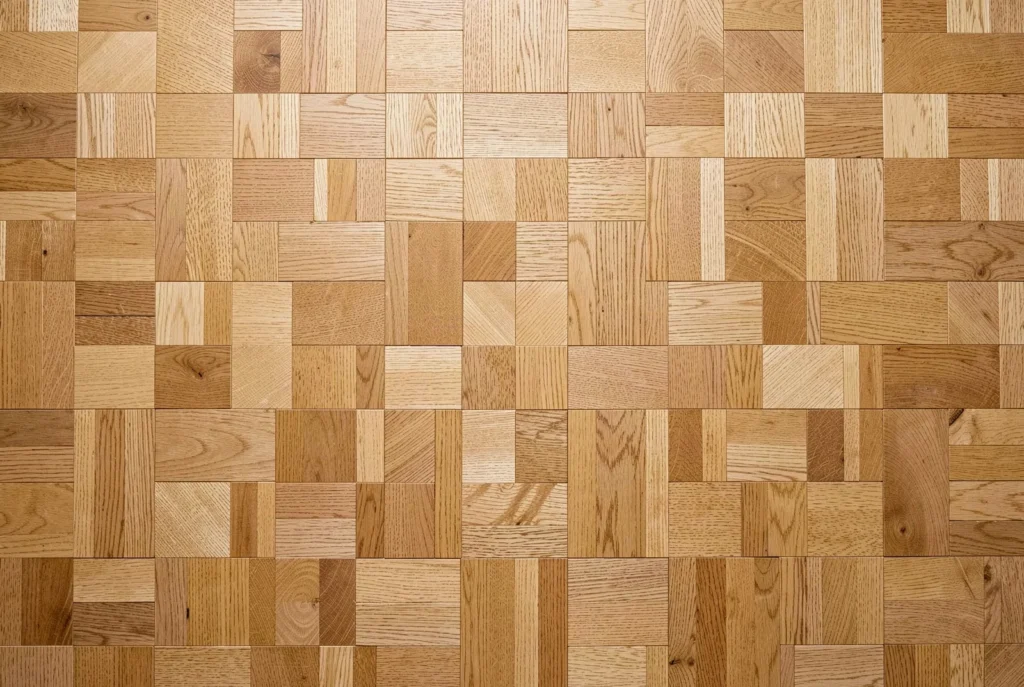
The short answer: chequerboard mosaic is the most affordable of the traditional parquet patterns — solid oak 7 to 8 mm thick, supplied in pre-assembled tiles and glued to a flat subfloor, from €27.18/m² incl. VAT with us. It brings instant character for less than a standard wide board.
What is mosaic parquet?
Mosaic parquet is made of small solid wood slats, generally 7 to 8 mm thick, assembled into squares. Each square groups several slats running the same way, and neighbouring squares are turned through 90°, which creates the characteristic chequerboard effect. The tiles arrive pre-assembled, held by a net or kraft paper, which makes laying far quicker than slat by slat. Once glued and the backing removed, the whole surface is sanded and finished in place.
It is an old principle — it covered millions of square metres of twentieth-century homes and schools — that is coming back for its graphic quality and its controlled cost.
Mosaic, herringbone, chevron, Versailles
| Pattern | Base unit | Installation | From (incl. VAT) |
|---|---|---|---|
| Mosaic / chequerboard | Tile of solid slats 7–8 mm | Glued only | €27.18/m² |
| Herringbone | Rectangular board, square ends | Glued or click | €32.40/m² |
| Chevron | Board cut at 45° or 60° | Usually glued | €55.20/m² |
| Versailles panels | Assembled square panel | Glued | €55.20/m² |
See chevron, herringbone and point de Hongrie and Versailles panels.
Why is mosaic so affordable?
Not for lack of quality — it is solid oak throughout, not a veneer. The explanation is industrial: mosaic makes use of small sections that could never produce a long board, so material yield is excellent, and manufacture in pre-assembled tiles is highly automated. You get genuine solid wood, sandable, for less than many engineered boards. Our solid oak mosaics run from €27.18 to €28.38/m² incl. VAT by grade, and come from our Belgian stock, BE-02.
How is it laid?
Fully bonded, exclusively — the thin section rules out floating or nailed installation. The subfloor must be faultless: at 7–8 mm, mosaic forgives nothing, so the flatness tolerance drops to 3 mm under a 2 m rule and a levelling compound is very often needed. See levelling and flatness. Set out the pattern from the centre of the room before any adhesive goes down, so the chequerboard stays symmetrical. Apply adhesive with a fine notched trowel over limited areas, remove the net or kraft after curing, then sand and finish on site. The perimeter gap remains compulsory — see expansion gaps.
Where does it work?
Its thin section makes it especially useful in renovation when height is tight: 8 mm plus 1 mm of adhesive fits where a 14 mm board will not. See choosing thickness. Visually, the chequerboard works best where you actually see it: entrance halls, wide corridors, studies, uncluttered living rooms. It also breaks the single direction of straight boards and removes the corridor effect — see hallways and small rooms.
Frequently asked questions
Is mosaic suitable for underfloor heating?
Yes, and it suits it very well: the thin section gives low thermal resistance, and full bonding transmits heat efficiently. See underfloor heating.
How long does it last?
An 8 mm solid oak mosaic has roughly 5 to 6 mm of usable wood above the glue line, allowing several sandings — more than most engineered boards. See how long a wood floor lasts.
Does the chequerboard date?
It has been present in European buildings for over a century: it belongs to the classical register rather than to fashion. Grade and finish date a floor far more than the pattern.