


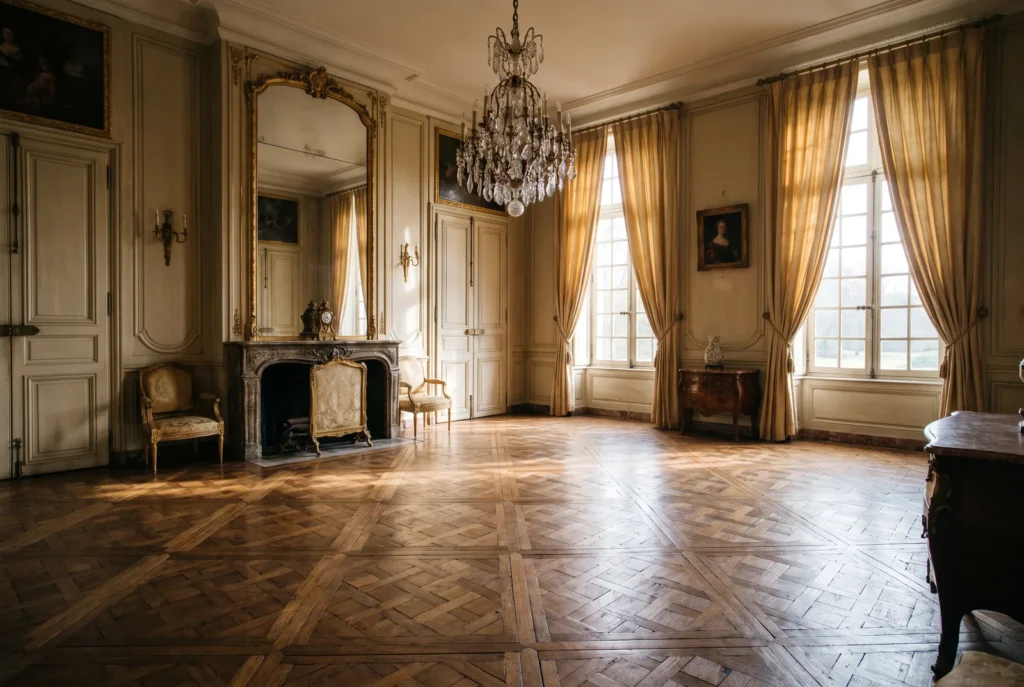
This is the pattern that moves a floor into another category. A Versailles panel is not one board among others: it is a complete geometric assembly, delivered as squares, that transforms a room. It also has requirements worth knowing before you commit.
Where it comes from
The panel known as “Versailles” appears at the end of the 17th century. It was designed to replace the marble floors of grand houses: warmer, quieter, and above all lighter for upper storeys.
The principle has stayed the same: a square frame encloses a pattern of boards interlaced on the diagonal. The traditional panel measures around 96 × 96 cm, though formats from 60 to 120 cm exist today.
What it does to a room
A Versailles pattern does not read like a plank floor. It creates a geometric grid that structures the floor and immediately gives the impression of a room that has been drawn rather than merely covered.
Practical consequences:
- The pattern needs space to read. Below 20 m², the panels are cut on every side and the design stops being perceptible. A Versailles corridor makes no sense.
- It draws the eye downwards. In an already busy room — patterned wallpaper, strong furniture — that can be a lot.
- It works remarkably well in square volumes and under high ceilings.
Installation: the real subject
This is where the budget is decided, often more than on the price of the wood.
- Gluing is mandatory, onto a perfectly flat subfloor. A panel is rigid: it does not follow defects, it reveals them. Prior levelling is almost always necessary.
- The setting-out line is decisive. A panel laid half a degree out compounds across the whole room and the pattern visibly drifts. You normally start from the centre of the room, not from a wall.
- The perimeter cuts take time and precision. Many fitters plan a border or a straight-board surround to absorb the edges.
- This is not a DIY job. Unlike a click floor, laying panels requires an experienced professional.
The budget, honestly
Three items add up:
- The panel itself, dearer per square metre than an equivalent board: the assembly represents a great deal of workshop labour.
- Waste, around 15% — the highest of any pattern, because a cut panel is never reusable elsewhere.
- Installation, appreciably higher than a straight lay, levelling included.
You have to look at the total installed cost, not just the price per square metre of the product.
Solid or engineered?
The traditional Versailles panel was solid. Today the engineered version dominates, and for good reasons: a large solid panel moves enormously with humidity, and over 96 cm a side, that movement becomes hard to control. Engineered solves the problem and stays compatible with underfloor heating.
The other panel patterns
Versailles is the best known but not the only one. There are also the Chantilly, Aremberg and Soubise panels — variants of the same family with different interlacing. And for a more accessible geometric effect, chevron or herringbone offers a considerably less demanding alternative, both in installation and in budget.
The advice
If Versailles tempts you for a room under 25 m², take the time to simulate the pattern to scale on a plan. Count the whole panels that remain visible: if there are fewer than six, the pattern will not express itself and a chevron will give a better result for less money.