

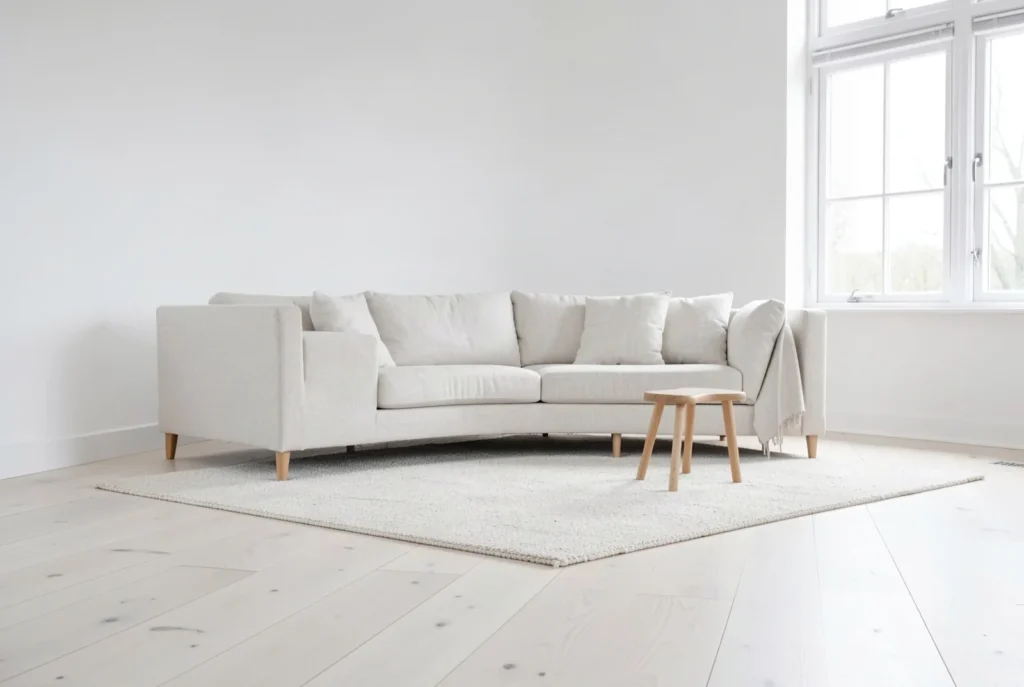
The short answer: the Scandinavian look rests on three precise choices: a very pale, almost whitewashed oak, a wide board laid straight, and a strictly matt oiled finish that refuses any sheen. Everything else is about the room as a whole, not the floor.
What defines a Scandinavian floor?
The Nordic style is not a superficial decorating fashion: it follows from a real climatic constraint. At Scandinavian latitudes daylight is scarce for much of the year, and the whole interior architecture aims to capture and return it — which explains the dominance of pale, matt surfaces.
Applied to the floor, that gives four constants: a very pale tone (natural, whitewashed, limed or soaped oak); a strictly matt finish that diffuses light instead of throwing it back in highlights; wide, long boards laid straight for a calm, minimally fragmented plane; and a quiet grade with few knots and little contrast. See our Nordic range, from €32.40/m² incl. VAT.
Which tone exactly?
| Treatment | Result | Note |
|---|---|---|
| Pale natural oak, matt oil | Softest, slightly golden undertones | Easiest to live with and to match |
| Whitewashed oak | Frankly pale, almost milky | Maximum enlarging effect |
| Limed oak | Grain picked out in white, strong texture | More rustic-Nordic |
| Soaped oak (white oil) | Bare-wood look, very matt, cool tones | The most authentically Scandinavian |
| Ashy grey oak | Cool, contemporary | Careful in dim rooms |
The trap is a heavy grey. Very common a decade ago, it has aged badly and it chills a north-facing room considerably. Warm or neutral pale tones are safer over time. See white and limed floors and choosing a tone.
Which board format?
The Nordic style favours width and length. A board of 190 to 260 mm over 2 m long creates exactly the continuous plane sought: few joints, few breaks, a sense of calm. That format suits generous rooms; in a living room under 20 m², drop to 160–190 mm to avoid intrusive cut edges. See board width and our XXL boards, from €26.40/m² incl. VAT.
Patterns are best avoided if you want Nordic rigour: herringbone and chevron belong to a French and central-European tradition. They are beautiful, but they tell a different story.
Oiled finish?
It is the coherent choice, for two reasons. The look: oil penetrates the wood instead of forming a film, preserving the bare-wood feel. And the upkeep: it repairs locally, which matters in a home where people walk barefoot on a very present pale floor. A good matt lacquer comes close visually and needs less routine care — a reasonable compromise in a busy household. See oiled, lacquered or unfinished.
Is a very pale floor impractical?
It does not get dirtier, it simply shows different things: hairs, dark crumbs and soil, while forgiving dust very well. Two measures make it comfortable day to day: a doormat, and the Nordic rule par excellence — shoes off at the door. That is what lets these pale floors last. See hardness and scratches.
Frequently asked questions
Does it suit a period apartment?
It is a strong statement, and it works when assumed: a contemporary pale floor under period mouldings. For historical coherence, look at chevron instead — see the Haussmann floor.
Does whitewashed oak yellow over time?
Oak naturally darkens under light, and a whitening treatment slows that without cancelling it. Maintaining with an oil of the same tone keeps the effect.
Is it compatible with underfloor heating?
Perfectly, glued and in a controlled thickness. See underfloor heating and choosing thickness.