

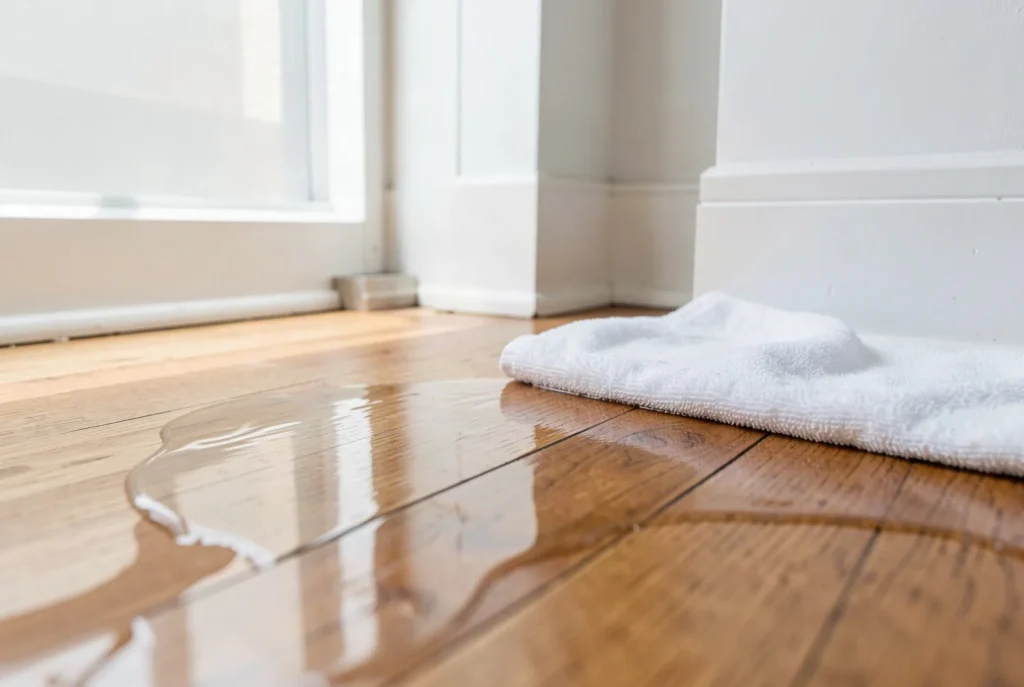
The short answer: act within the first six hours. Shut off the water, remove standing water, lift the skirtings to open the expansion gaps, and ventilate without overheating. A floor dried quickly and gradually is very often saved; a floor left wet for forty-eight hours is almost always lost.
The first hours
Speed matters more than perfection. In order: shut off the source; cut the power to the area if water reaches sockets or appliances; remove standing water with a wet vacuum, squeegee or cloths — every litre removed is a litre the wood will not absorb; clear the room of furniture, rugs and boxes, since anything left in place blocks drying and leaves a ring; photograph everything before you start repairing, which is essential for the insurer; and lift the skirtings on the affected areas.
That last point is the one most often forgotten, and it is what saves the most floors. A swollen floor that is free to expand very often settles back as it dries; blocked against its skirtings, it lifts and destroys its joints. See expansion gaps.
Drying without making it worse
The classic mistake is to heat hard to speed things up. Fast drying dries the surface far quicker than the core, causing splits, cupping and permanent delamination.
- Ventilate generously; aim fans along the floor rather than at it.
- Use a dehumidifier rather than a heater. It is the right tool: it pulls moisture from the air, which gradually draws it from the wood.
- Keep a moderate temperature, around 18–22 °C. No heat gun aimed at the boards.
- Count in weeks, not days. A genuinely dry substrate and floor often take two to four weeks.
- Switch off underfloor heating or keep it very low: heating under a saturated floor is destructive.
The only reliable criterion is measurement: relative humidity stabilised at 45–65 % and a compliant substrate reading. See humidity and wood floors.
What can be saved?
| Situation | Prognosis |
|---|---|
| Spill wiped within the hour | No damage expected |
| Slight joint swelling, dried within 48 h | Often back to normal |
| Marked cupping, joints intact | Often recoverable after full drying then sanding |
| Boards unclipped, joints open | Partial lifting required |
| Glued floor debonded in patches | Remove the zone, redo the substrate |
| Waste water or days of standing water | Full removal, a hygiene issue |
| Substrate saturated | Removal compulsory to dry it |
Important: never judge a swollen floor before it is fully dry. Wood recovers a large part of its shape. Many floors lifted in a hurry could have been saved — wait several weeks before deciding.
The insurance claim
Declare quickly; contracts usually set a short deadline. Build a file: dated photographs taken before you intervene, purchase invoice, exact reference, area affected. Do not wait for the assessor before drying — contracts require you to limit the damage — but document what you do. Keep a few damaged boards as physical evidence, and be aware that compensation usually accounts for the age of the covering. See flats and shared buildings for how responsibility is shared.
Frequently asked questions
Should the floor come up to dry the substrate?
If the substrate is saturated, yes: water trapped under a glued floor does not escape and ends in mould. A moisture measurement settles the question better than a visual impression.
Can I use a fan heater to speed things up?
No. It is the most frequent cause of irreversible damage after water ingress. Dehumidifier and ventilation, at a moderate temperature.
Can a water ring disappear?
A surface ring on an oiled finish often fades after local sanding and re-oiling. Under a lacquer the mark is beneath the film and the zone must be redone. See repairing a board.