


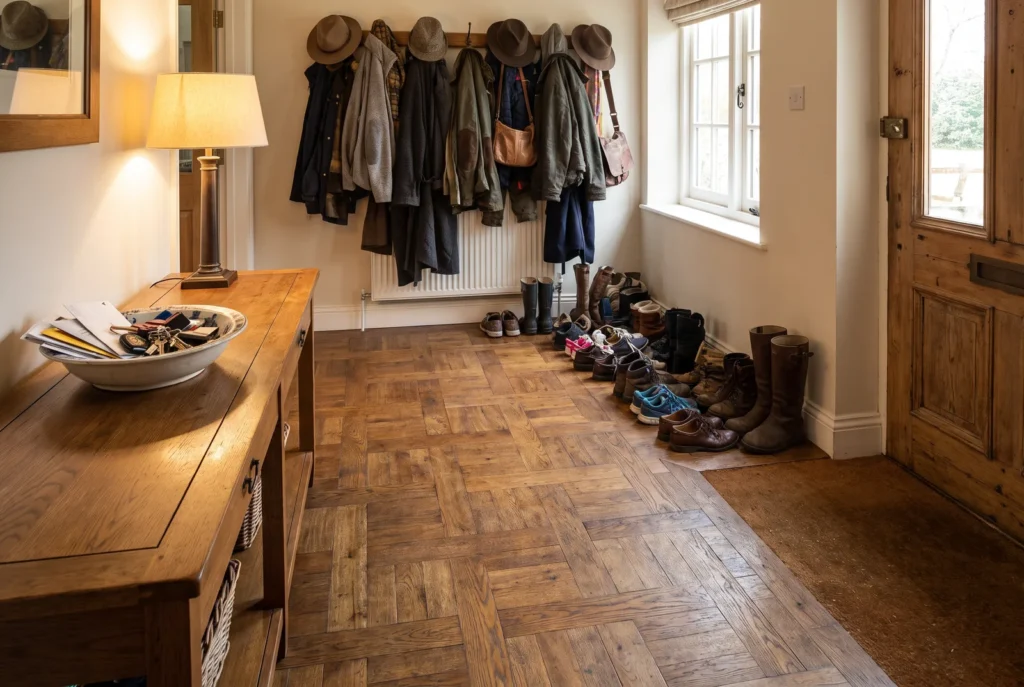
On a product page you come across “class 23” or “class 32”. These figures come from a European standard and mainly serve to compare floor coverings with one another. Here is how to read them, and why they only tell part of the story for a wooden floor.
How the code is built
The classification is defined by EN ISO 10874. It reads as two digits.
The first digit gives the setting:
- 2 — domestic use, in a home.
- 3 — commercial use: office, shop, hotel.
- 4 — industrial use.
The second gives the intensity of traffic:
- 1 — moderate
- 2 — general
- 3 — heavy
The full table
| Class | Corresponds to |
|---|---|
| 21 | Guest bedroom, dressing room — light traffic |
| 22 | Bedroom, living room — normal domestic use |
| 23 | Living room, corridor, entrance — heavy traffic in a family home |
| 31 | Hotel room, small individual office |
| 32 | Office, classroom, shop |
| 33 | Reception hall, restaurant, department store |
For a home, aiming for class 23 covers every use, including the entrance and the corridor. Class 31 and above belong to commercial settings.
The limit of the system for a wooden floor
Here is what the data sheets do not always say: this classification was designed for coverings whose wear layer is a non-renewable decorative surface — laminates, vinyls, carpets. When it is worn, you replace the floor.
A wooden floor works differently. Its wear layer is real timber, which can be sanded and refinished. A floor with a tired finish is not a floor to throw away: it is a floor to renovate, often for half the price of replacement.
The result: for a wooden floor, two criteria weigh more than the use class.
What really counts
1. Wear-layer thickness
That is the real capital of lifespan. A 2.5 mm layer allows about one sanding, 3.2 mm allows two, 6 mm allows four or five. Each sanding gives the floor another twenty years of service.
2. The finish
It is the finish that takes the hits, not the wood. A factory-applied industrial-grade polyurethane lacquer resists far better than an oil applied on site — but the oil repairs locally without redoing everything.
And the hardness of the wood?
It is measured by the Brinell test (EN 1534) and expressed in N/mm². Oak sits around 3.4, walnut slightly below, pine considerably lower. It is a useful indicator to compare species, but it predicts little about everyday scratching: that depends first on the finish and on what gets dragged across the floor.
How to choose in practice
- Standard home — class 23, wear layer 2.5 mm minimum, finish as you prefer.
- Home with children and pets — class 23, layer 3 mm or more, a grade that forgives marks, lacquer or hardwax oil finish.
- Commercial premises open to the public — class 32 minimum, layer 3 mm or more, factory finish.
- Little-used bedroom — class 22 is enough, no need to overpay.
Unsure about a reference?
Every product page in the catalogue states its use class and its wear-layer thickness. If the information is missing or you hesitate on a specific project, write to us — we answer within 24 to 48 working hours.