

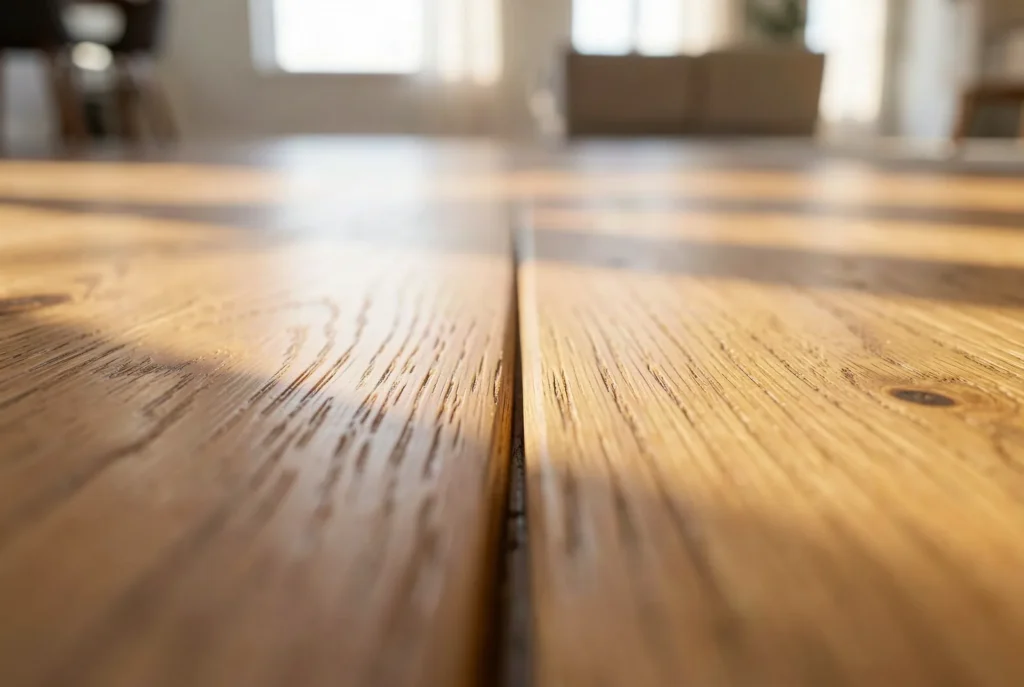
The short answer: a square edge gives an almost unbroken surface and suits contemporary interiors, but it demands a perfectly flat subfloor and forgives nothing. A bevel draws each board, absorbs small installation tolerances and copes better with seasonal movement. For most projects a micro-bevel is the safest choice.
What is a bevel?
The bevel is a chamfer machined on the top edge of the board. Once two boards meet, the two chamfers form a small V-groove along the joint. It is not only decorative: it hides thickness tolerances, it makes the winter shrinkage gap invisible, and it protects the arris from chipping.
The four edge profiles
| Profile | Groove depth | Effect | Subfloor demand |
|---|---|---|---|
| Square edge | none | Continuous surface, one large plane of wood | Very high |
| Micro-bevel | 0.5–1 mm | Joint sensed rather than seen | Standard |
| Bevel on long edges | 1–2 mm | Lengthens the room visually | Standard |
| Bevel on 4 sides | 2–3 mm | Each board drawn individually | Forgiving |
When is a bevel the better call?
- Renovation, where no old subfloor is truly flat.
- Floating installation, which always keeps slight movement — see glued, floating or nailed.
- Underfloor heating, where heating cycles widen the seasonal gap — see wood flooring over underfloor heating.
- Wide boards, which move more in absolute terms — see choosing board width.
- Rustic grades, where the V-groove is part of the character — see our rustic oak.
Is a bevel harder to keep clean?
Slightly. The groove collects dust, so a vacuum with a soft brush head works better than a broom. It does not hold water any more than a square edge: on a properly finished floor the chamfer is sealed like the rest of the surface.
Bevels and sanding
A full sanding gradually removes the chamfer, so a four-sided bevelled floor comes back closer to a square edge. Worth knowing if you like the board-by-board look. It also consumes a little of the wear layer — see wear layer thickness.
Frequently asked questions
Does a bevel mean a cheaper floor?
No. It is an aesthetic convention, not a quality marker. Some of the most expensive floors — solid oak, traditional panels — are bevelled by principle. Quality is judged on species, wear layer, grade and finish.
Can I mix bevelled and square-edge boards?
Not in rooms that are visually connected: the transition shows immediately. Between floors, or in an isolated room, it is unnoticeable.
Does the edge profile change the price?
Marginally. Price is driven by species, grade, format and finish. Our engineered oak starts at €22.80/m² incl. VAT and runs past €100/m² for large formats, whatever the edge.