


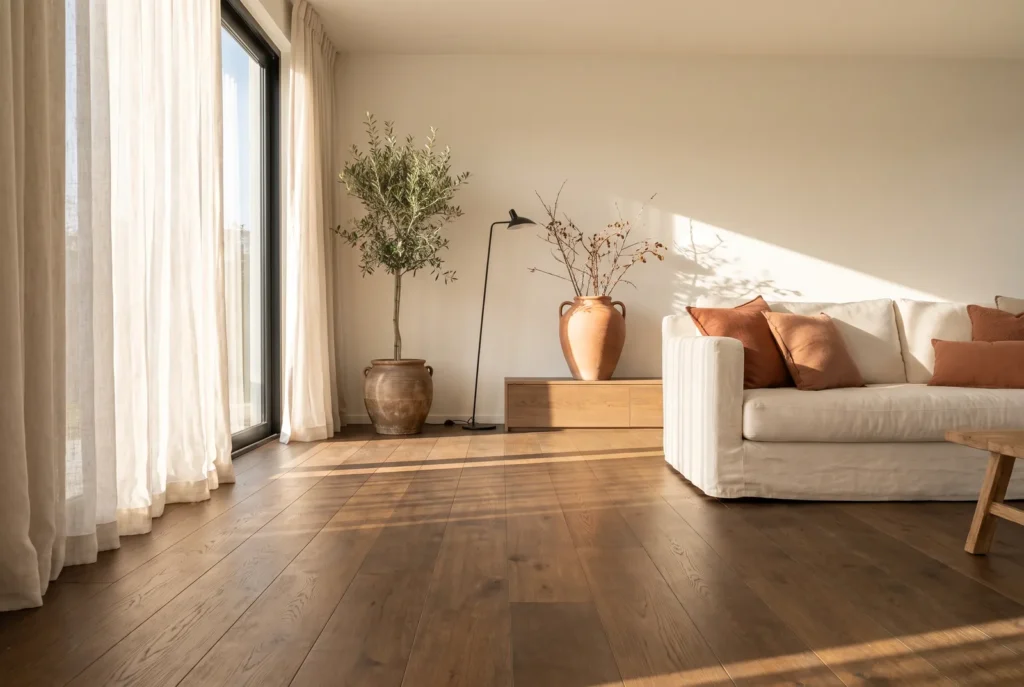
Fumed oak intrigues people: a deep brown, almost grey, very different from a stained oak. The difference is not cosmetic — it lies in the process, and it has very concrete consequences for the life of the floor.
It is not smoke
Despite the name, fumed oak has not been through a smokehouse. The traditional process consists of sealing the timber in an airtight chamber in the presence of ammonia vapour. The vapour reacts with the tannins naturally present in oak, and that chemical reaction darkens the wood.
It is an old process, discovered by accident in English stables: the oak beams above the horses were noticed to darken over time. The ammonia in the urine was the cause.
The essential difference: the colour goes through
That is the whole point of the process, and what sets it apart from an oak simply stained on the surface.
- A stained oak receives a pigment laid on the wood. A deep scratch goes through the colour and reveals the pale wood underneath: the mark is immediately visible.
- A fumed oak has reacted through several millimetres of thickness. A scratch stays within the coloured material and shows far less.
That is a real everyday advantage, particularly with children or pets.
Why the boards are never identical
The reaction depends on the quantity of tannins, and that varies naturally from tree to tree, and even within a single log. As a result, fumed oak always shows tone variation from board to board, sometimes pronounced.
It is not a manufacturing defect, it is the signature of the process. But you have to accept it: if you want a perfectly uniform floor, fumed is not the right choice. The blending happens during installation, by drawing from several packs at once rather than emptying them one by one.
Intensity: from light to very dark
Exposure time determines the depth of the colour. It runs from a warm, slightly greyed brown that keeps the oak figure clearly readable, all the way to a very dark, almost black brown where the grain is barely discernible.
Two useful remarks:
- On very dark tones, dust shows. Far more than on natural oak.
- Fumed, like all dark timbers, absorbs light. In a dark room it will close the volume further. It gives its best in a bright space, contrasting with pale walls.
Fumed, thermo-treated, dark-oiled: do not confuse them
| Process | Principle | Effect |
|---|---|---|
| Fumed | Ammonia / tannin reaction | Colour through the thickness, natural variation |
| Thermo-treated | High-temperature heating without oxygen | Colour through the thickness, more stable but more brittle |
| Stained / coloured oil | Pigment applied to the surface | Uniform colour, but scratches show |
Renovation: the point to know
This is the real limit of fumed oak. The reaction has coloured the wood over a few millimetres only. A deep sanding can reach the pale wood underneath and bring back lighter patches.
In practice: a light refresh sanding passes without trouble, a full sanding should be entrusted to a professional who knows the product. Check the wear-layer thickness and keep this constraint in mind.
Which finish
Oil is the finish that does a fumed oak most justice: it deepens the brown without freezing it. A matt lacquer works too. Gloss should be avoided — it gives a nail-varnish look that breaks the natural character of the process.
To be seen in person, without exception
Fumed oak is, along with walnut, the timber screens render worst: it systematically appears greyer or redder than it is. Ask for a sample and look at it at home, morning and evening.