

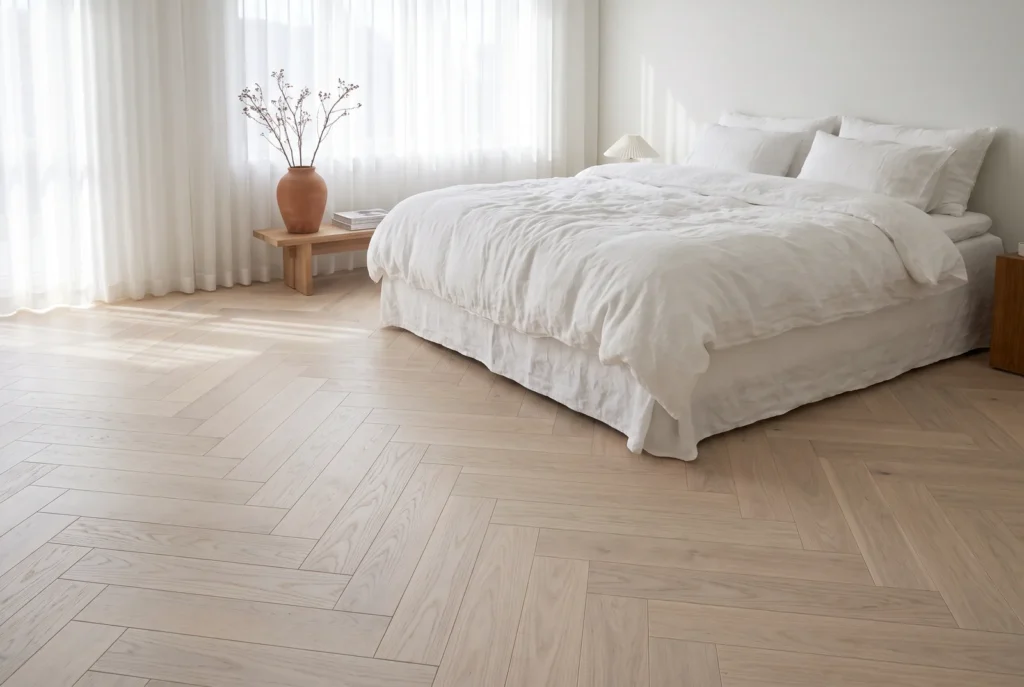
Oak accounts for the vast majority of wood floors sold in Europe, and for good reasons. But it naturally leans towards honey and gold, which does not suit everyone. Here are the three most serious pale alternatives, and their real limits.
Ash
This is the genuine alternative to oak, and by far the most available.
- Colour — cream white to very pale beige, distinctly cooler than oak. The heartwood can show brown zones known as olive ash, highly decorative but irregular.
- Grain — pronounced, long, very graphic. More assertive than an oak of equivalent grade.
- Hardness — comparable to oak, sometimes slightly above. Density around 700 kg/m³. No compromise to make on that front.
- Behaviour — it yellows a little over time, less than oak. A whitened finish or a UV-blocking lacquer limits the shift.
For whom: those who want pale without losing robustness. It is the only one of these three you can put in a hallway without reservation.
Maple
- Colour — the palest of the three, almost milky white, very uniform.
- Grain — extremely discreet, virtually smooth. It is a floor that disappears, which is exactly the effect sought in a minimalist interior.
- Hardness — North American hard maple is denser than oak; European maple (sycamore) is less so. The difference between the two is real: check the species on the product page.
- The weakness — it yellows markedly under UV, and unevenly. A rug left for two years leaves a clear imprint. That is the main criticism made of maple as a floor.
For whom: very contemporary interiors, provided you accept the colour shift or choose a UV-filtering finish.
Birch
- Colour — very pale blond, slightly pink. It is the timber of Scandinavian furniture.
- Grain — fine, soft, sometimes with figured waves.
- Hardness — clearly below oak. That is the point to know: birch dents more easily.
For whom: bedrooms, studies, rooms with moderate traffic. To avoid in a hallway, a main corridor, or with a large dog.
The summary table
| Species | Colour | Grain | Hardness | Change under light |
|---|---|---|---|---|
| Oak | Honey, gold | Pronounced, ray fleck | The benchmark | Darkens and gilds |
| Ash | Cream, cool | Very graphic | ≈ oak | Yellows slightly |
| Maple | Milky white | Very discreet | Varies by species | Yellows markedly |
| Birch | Pink blond | Fine, soft | Lower | Moderate |
The alternative many end up preferring
A whitened, limed or white-oiled oak gives a pale result while keeping the hardness, the availability and the price of oak.
It is often the best compromise: you get the clarity you were after without the constraints of a rarer or softer species.
A warning about samples
Pale timbers are the ones screens render worst — they systematically appear greyer or yellower than they are, depending on the device. On these species more than any other, order a sample and look at it on the floor in the room, morning and evening.