


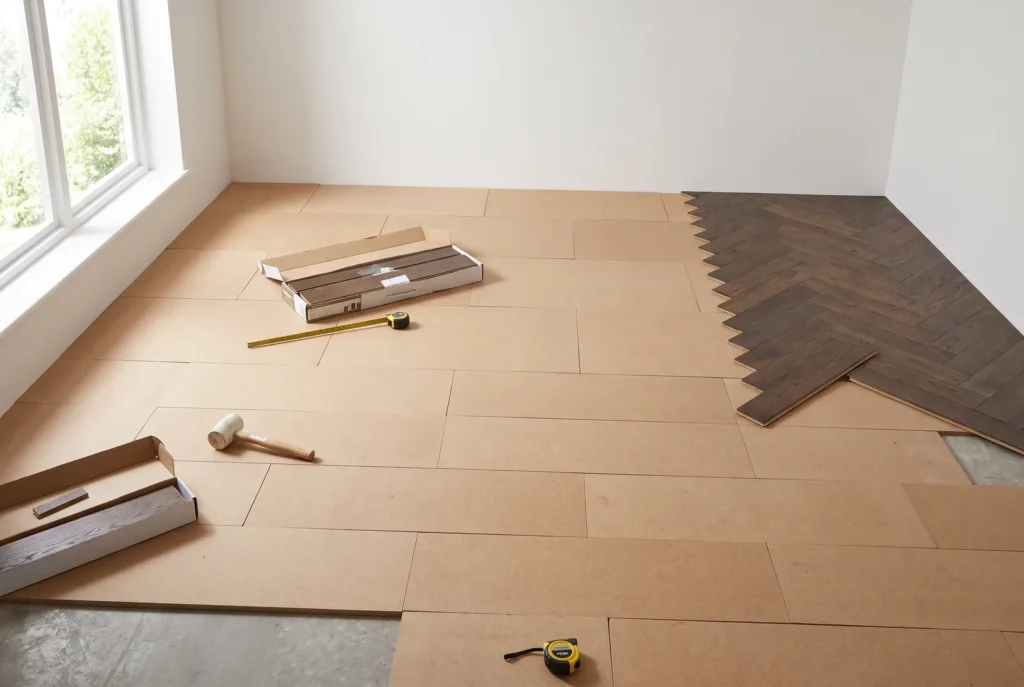
It is the product chosen last, often at random, and it decides the comfort of the floor for twenty years. The underlay of a floating floor is not a simple mat: it has four distinct jobs, and no underlay does all four equally well.
The four jobs
- Correct micro-irregularities in the subfloor. It will not level out a hump, but it absorbs the small differences that would make the floor click.
- Reduce noise. Two different noises — more on that below.
- Act as a moisture barrier from the subfloor, over a concrete slab.
- Add some comfort underfoot and a little thermal insulation.
The two noises everyone confuses
This is the most common confusion, and it leads people to buy the wrong product.
- Impact noise transmitted to the neighbours below. Measured in dB of reduction (ΔLw). That is what appears in big letters on the pack — “20 dB”, “22 dB”. If you are in a flat, that is your criterion, and it may be imposed by the building's rules.
- Noise heard inside the room itself, that knock when you walk. It is measured by a different indicator, often absent from the data sheet. Yet it is the one you will hear every day.
An underlay that excels on the first criterion can be mediocre on the second. If noise inside the room worries you, the real answer is not an underlay but a glued installation.
The materials
| Type | Strengths | Limits |
|---|---|---|
| Polyethylene foam | Cheapest, integrated vapour barrier available | Compresses over time, weak acoustics |
| Wood fibre | Excellent on in-room noise, rigid, levels well | Dislikes moisture, needs a separate vapour barrier |
| Cork | Good acoustic compromise, natural, durable | Higher price |
| Extruded polystyrene | Good insulation/price ratio, does not compress | Average in-room acoustics |
| Rubber / SBR | The best on impact noise | Expensive, heavy |
Thickness: more is not better
Counter-intuitive but important. An underlay that is too thick or too soft tires the click joints: the boards sink slightly at every step, the locking system works, and eventually it comes apart.
For a floating engineered floor, the sensible range is 2 to 5 mm. Beyond that you are after thermal insulation, which belongs in the screed build-up. Always check the flooring manufacturer's specification, which takes precedence.
The vapour barrier: mandatory on concrete
Over a concrete slab, even an old one that looks dry, a polyethylene film of at least 200 microns is essential, turned up a few centimetres along the walls and overlapping adjacent strips by around twenty centimetres.
Over an existing timber floor you must not use a vapour barrier: the boards need to breathe upwards, otherwise moisture is trapped between the two layers.
The underfloor heating case
Here the underlay works against you: it insulates, whereas you want to transmit heat. You need the lowest possible thermal resistance, below 0.15 m²·K/W, and you must avoid thick wood fibre entirely.
But the real answer with underfloor heating remains a glued installation.
What to remember
In a flat, look at the ΔLw and the building's rules. In a house, favour wood fibre or cork for in-room sound comfort. Over concrete, never skip the vapour barrier. And do not buy thicker in the belief that it is better.