

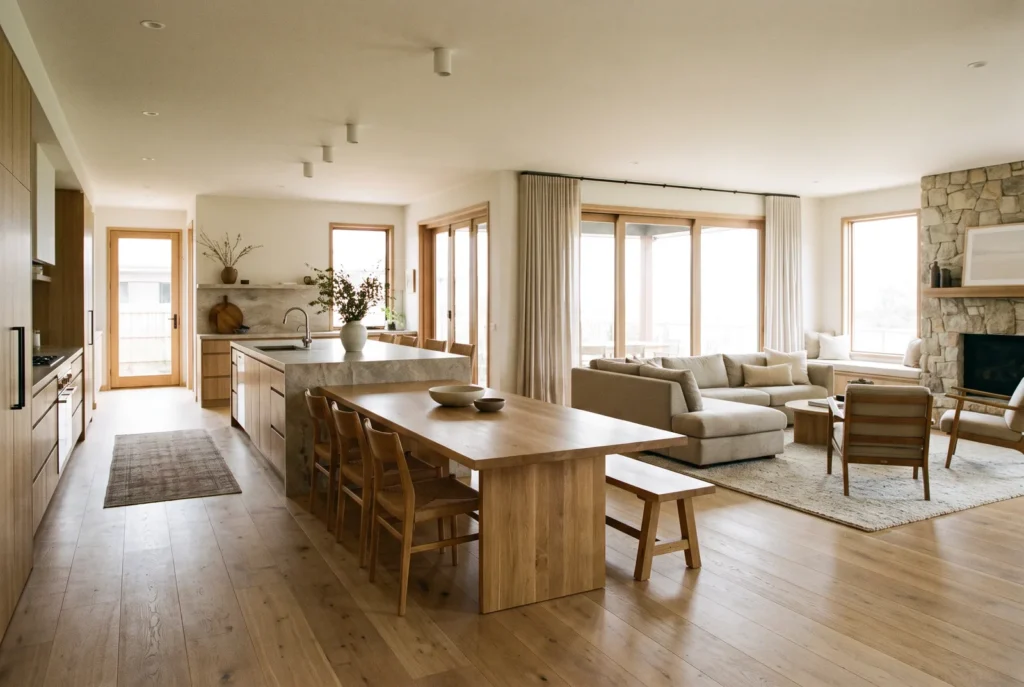
Laying the same floor everywhere is a fine option — continuity enlarges. But if you prefer to give each room its personality, here is how decorators reason, room by room.
The living room: the room that lives
This is where the floor works hardest and shows most. Wide or XXL planks for visual calm, a matte brushed finish to absorb daily life, and the grade that matches your household: calm if the interior is pared back, more knotted if the house lives loudly. A bright living room takes smoked oak; a north-facing one prefers blond — see also the effect of XXL planks in medium-sized rooms.
The bedroom: softness first
The barefoot room: this is where natural oil or a light brushing make full sense — you feel the material. Calm tones (blond, natural, light smoked) soothe; pattern is superb here in a discreet version, a blond herringbone for instance. Bonus soundproofing between floors: our acoustic insulation guide.
The kitchen: yes, wood belongs
Wood floors in kitchens are no longer taboo: oiled or matte-lacquered oak, a grade with some character, and splashes wiped within the day leave no trace. The useful precautions: avoid the very pale under a big family's sink, prefer a locally repairable finish (oil touches up with a pad), and play continuity with the living room in open kitchens.
Entrance, hallway, study
The entrance demands resistance (we devoted an article to it), the hallway likes a short pattern that rhythms the length, and the study is the ideal room to dare — a few m² of smoked chevron or Versailles make a complete décor.
To compose the whole: XXL in the living room, Nordic in the bedroom, Rustic in the kitchen — and the calculator to add up rooms without errors.