


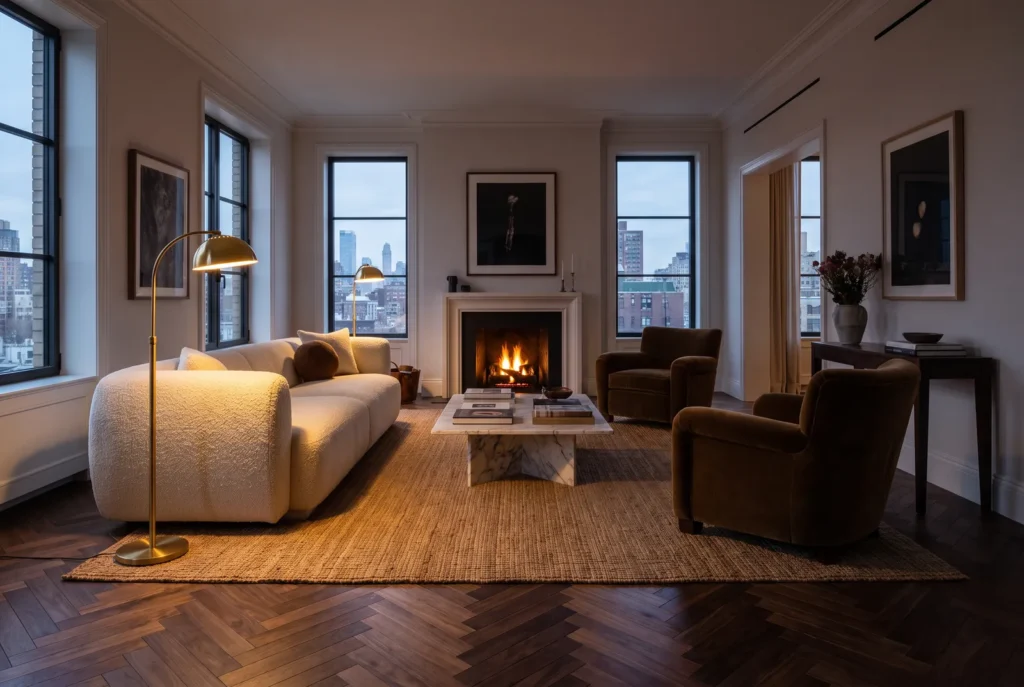
Walnut is the timber people notice. Where oak settles in quietly, walnut imposes a chocolate-brown tone that changes the atmosphere of a room completely. It is also a softer and more expensive wood, with a particular behaviour worth knowing about before you order.
Which walnut are we talking about?
In flooring, the usual walnut is American black walnut (Juglans nigra). It is the one that gives that dark, sometimes almost purplish brown, with strongly contrasted veining. European walnut (Juglans regia) exists too but stays rare and lighter, used more in cabinetmaking than on floors.
Its peculiarity: it lightens
This is the point many people discover after installation. Most timbers darken over time under light — oak takes on a golden patina, merbau goes deeper. Walnut does the opposite: it lightens. The deep brown of the first weeks shifts gradually towards a warmer, honeyed brown, especially in areas exposed to direct sun.
This is not a defect, it is the nature of the wood. But it means two things:
- A rug left in the same place for two years will leave a darker patch when you move it. It does even out, but it takes months.
- The tone you see on the sample is not exactly the one you will have in five years. It will be a little lighter and warmer.
Hardness: softer than oak
Black walnut has a density of around 660 kg/m³, against 700 for oak. On the Brinell test (EN 1534) it sits slightly below oak. In practice: it dents a little more easily.
Should you avoid it for that? No, but be clear-eyed about the use. In a living room or bedroom the difference is imperceptible. In a hallway where people walk in with street shoes, or in a busy corridor, oak takes it better.
Solid or engineered?
Walnut being costly, the vast majority of walnut floors are engineered: a walnut wear layer over a less noble substrate. It is a rational choice — you pay for the walnut where it shows, and you gain the stability of an engineered board.
Solid walnut exists, but its price reserves it for particular projects.
Which finish?
Walnut reacts strongly to the finish:
- Natural oil — deepens the wood, brings out the veining. It is the finish that does walnut most justice, but it needs regular maintenance.
- Matt lacquer — more protective, more uniform look, less depth. A good compromise for a busy room.
- Gloss lacquer — best avoided in our view: walnut is already dramatic, gloss makes it flashy and underlines every scratch.
Which rooms it works in
A dark floor absorbs light. In a dark or small room, walnut will tend to compress the volume further. It gives its best in:
- Bright rooms, where the contrast with pale walls works fully.
- Large volumes, where its depth creates a visual base.
- Bedrooms, where the warmth of the brown brings something oak does not.
One practical point often forgotten: on a dark floor, dust and footprints show far more than on a mid-tone oak. Not a deal-breaker, but worth knowing beforehand.
See it before you buy
Walnut is the timber for which a sample matters most: screens systematically render it redder or greyer than it is.