
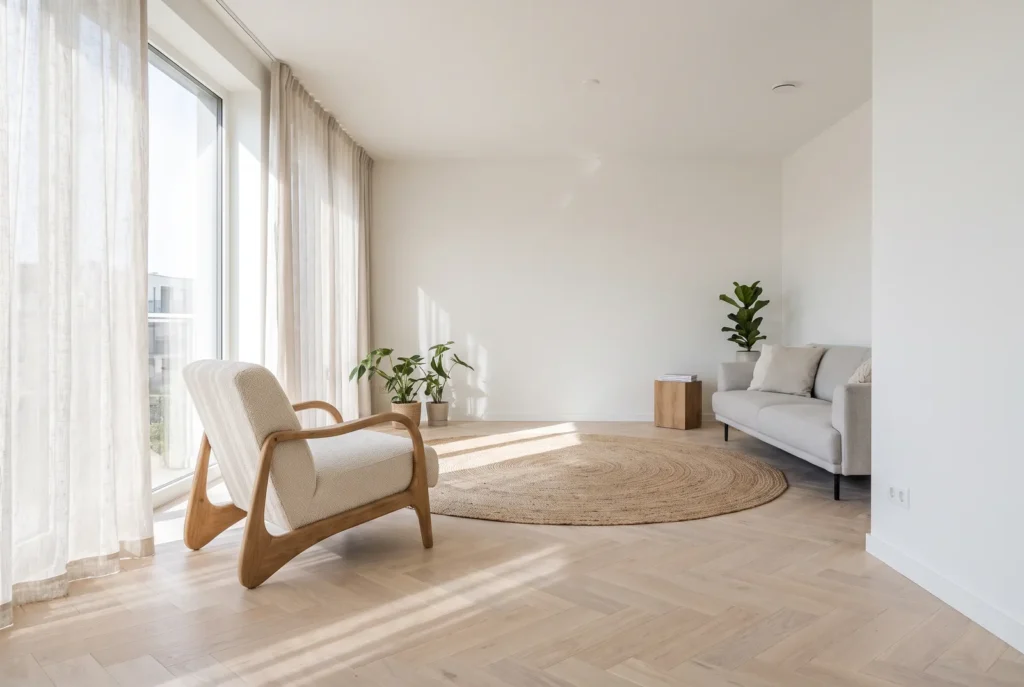
Take a straight plank, cut it into short modules, lay them at right angles to each other: you get herringbone — bâtons rompus in French, spina di pesce in Italian. A woven, almost textile pattern that brings movement to the floor without chevron's solemnity. It is the parquet on the rise in current renovations, for good reasons.
The woven effect
Unlike chevron, herringbone boards are not mitred: they cross at right angles, staggered. The eye reads not a ridge line but an interlacing — the floor seems braided. In low morning light every module reflects differently: the floor changes mood with the day, where a straight plank stays even.
In which interior?
- Apartment renovation: it evokes old parquet without imposing the classic style — perfect between mouldings and an open kitchen.
- Contemporary house: in blond oak it breaks the coldness of big open floors and glazing.
- Small rooms: the short module (400 to 700 mm) is easier to lay out than a long plank — hallways, entrances and bedrooms benefit.
- On the wall: as a headboard or behind a stove, the pattern laid vertically is a decorative panel in itself.
Blond, natural or smoked?
Blond oak herringbone with an invisible lacquer remains the safe bet of Scandinavian and japandi interiors. Smoked brown assumes the vintage charm — that of boutiques and Viennese cafés; pair it with cognac leather, green velvet and aged brass. In between, naturally oiled and lightly brushed brings out the grain and forgives daily life.
It is laid fully glued, along the main light; on heated screeds the short format is even an ally — see our underfloor heating guide. Allow 8 to 10% waste (the precise maths is in how many m² to order).
Our European oak herringbone — from raw 90 × 600 to smoked lacquered — lives in the Herringbone collection.