

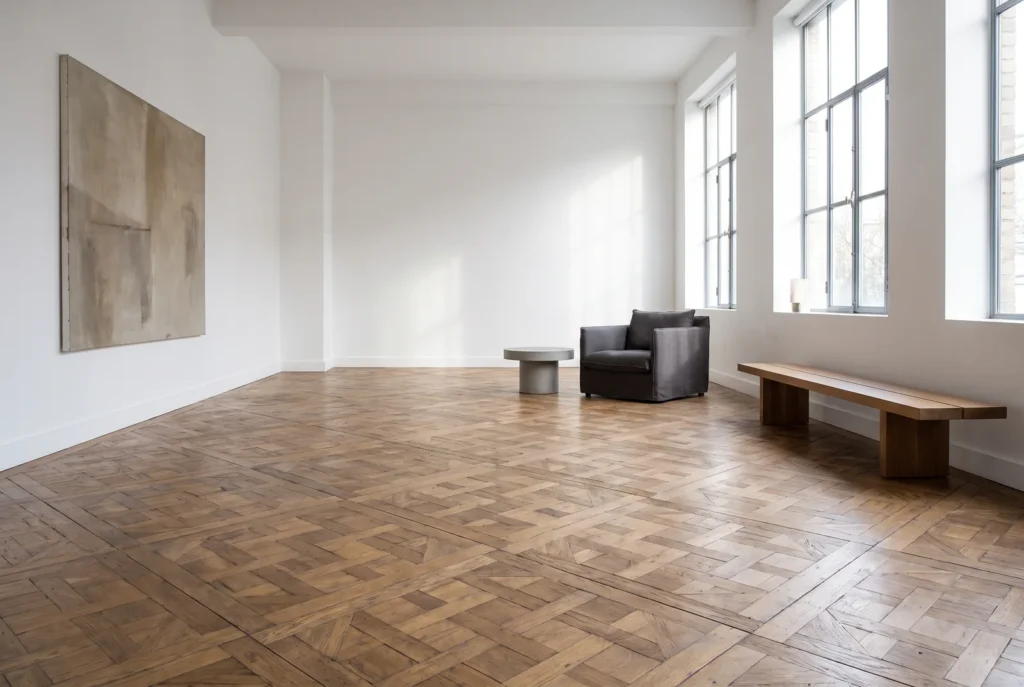
In 1684, the king's joiners were looking for a floor to replace marble, too heavy and too cold for the upper floors of Versailles. They drew a square panel with an interlaced frame and lattice, laid on the diagonal. Four centuries later the «Versailles panel» is still made almost identically — and it has never been more at ease than in today's interiors.
Why it works outside the château
The Versailles paradox: the simpler the interior, the more spectacular the floor. In a loft with white walls and bare volumes, a floor of French panels becomes the only décor — the equivalent of artwork hung on the floor. The diagonal enlarges the room, the big module (often 600 to 1000 mm square) slows the rhythm, and the eye does the rest.
Three ways to live with it
- The grand living room: panels across the whole surface, low furniture, natural light — the gallery spirit, without gilding.
- The single room: a lounge or dining room in Versailles, the rest of the floor in matching straight planks — the contrast makes the luxury.
- The wood rug: a few panels framed by a border at the centre of a room, like a permanent rug under the table.
Antique or contemporary?
In smoked, aged oak the panel tells the story — perfect in a house of character or an old apartment. In blond oak with an invisible lacquer it becomes graphic, almost abstract: the contemporary reading, rising in hotels and fine renovations. Either way, today's engineered panels glue down fully, including over underfloor heating (our guide).
Our French panels in European oak are in the Versailles and Premium Versailles collections; for a specific drawing, species or size, made-to-measure takes over where the collections stop.