

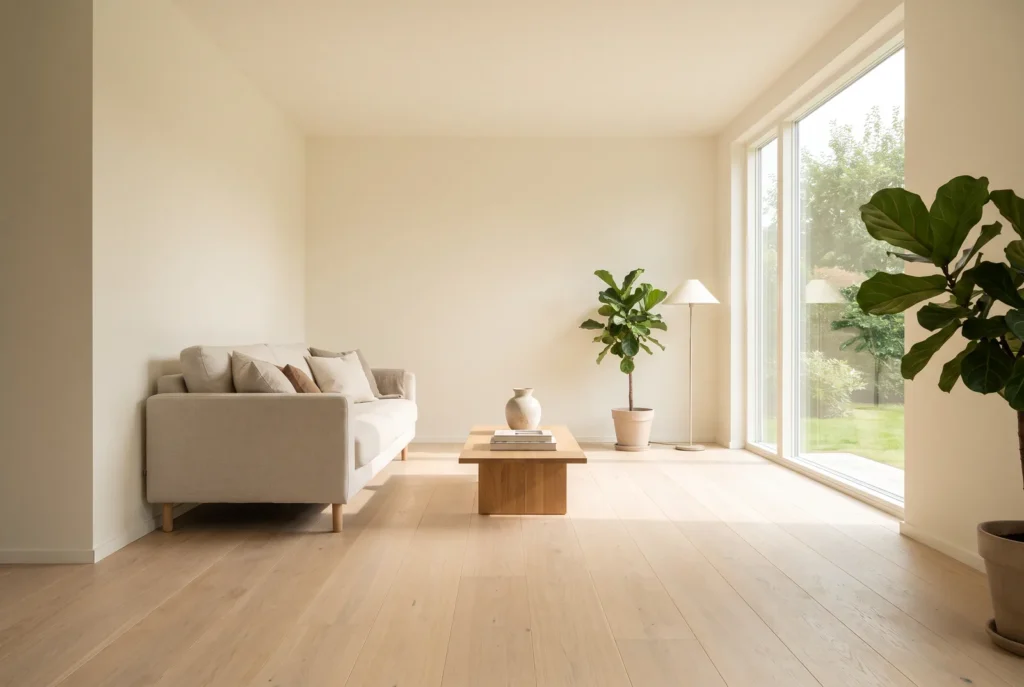
It is the most stubborn myth in flooring: «small room, small boards». The logic sounds airtight — and it is wrong. What visually shrinks a space is not big planks: it is lines. The more joints a floor has, the more the eye cuts it up, the more fragmented the room feels. A wide plank does exactly the opposite.
The visual mechanics
In a 14 m² living room, 90 mm boards draw some thirty rows; at 220 mm about a dozen remain. The floor becomes a surface, almost a sheet of wood, and the space reads in one piece. The effect strengthens when the plank runs along the room's length and towards the window: the vanishing lines pull the gaze outside.
The right reflexes in a small space
- Planks laid lengthwise, towards the main light source.
- Pale tone, matte finish: blond oak with invisible lacquer or natural oil reflects light without shine — a dark little room gains a full tone.
- Continuity: the same floor from living room to hallway to bedroom, without thresholds where possible, enlarges the whole storey at once.
- Skirtings matched or painted wall-colour: the floor runs to the wall without a visible frame.
What about knots, and patterns?
At great widths the wood selection shows: a calm grade stays serene, a rustic grade owns its character — a question of style, not rules. As for patterns, chevron works in a small room too, provided the boards stay narrow: the exception that proves the rule. For wide planks the real choice is selection and finish; our guide to wear classes and traffic helps for a busy hallway.
Our wide European oak — 180 to 260 mm — is gathered in the Wide plank and XXL collections; count your m² (just 5% waste with straight planks) with the calculator.