


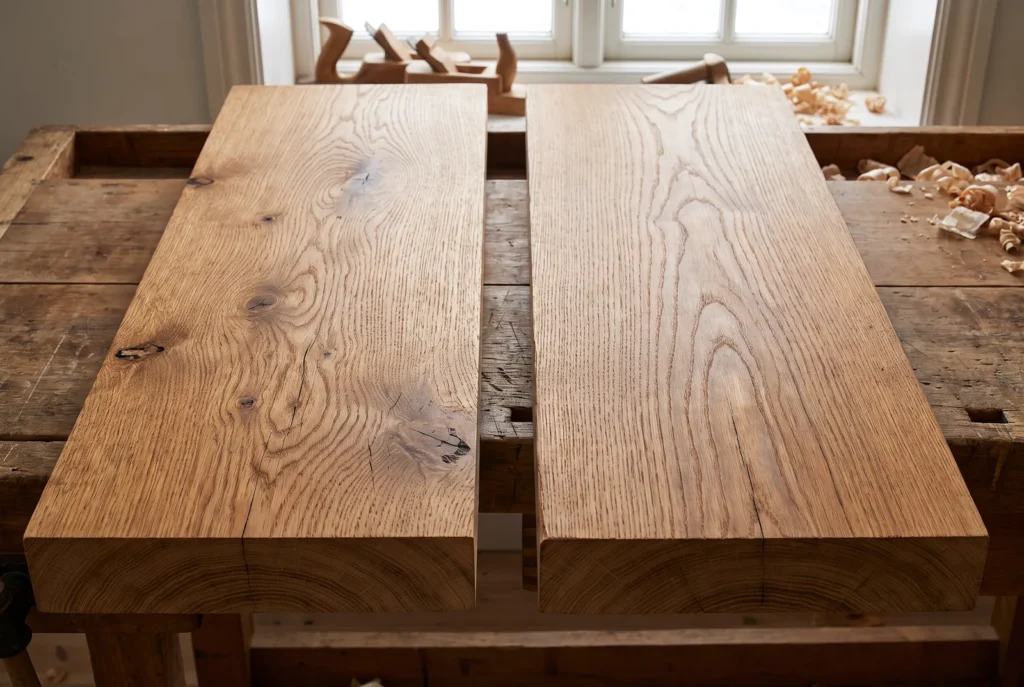
On a flooring catalogue, “oak” says very little until you know where the tree grew. European oak and American oak are two different timbers, with distinct looks and distinct behaviour. Here is what actually separates them, without the marketing.
Two families, several species
What we call European oak covers mainly two species: pedunculate oak (Quercus robur) and sessile oak (Quercus petraea). They grow in France, Germany, Poland and the Balkans. It is the historic timber of European flooring — the boards under every Haussmann apartment.
American oak means above all white oak (Quercus alba) and red oak (Quercus rubra), harvested in North America. White oak is the closest relative of European oak; red oak stands further apart, with a distinctly pinker cast.
The look: the real difference
This is where it is decided, and it is visible to the naked eye on a sample.
- Grain. European oak often has a more irregular figure, with waves and medullary rays — those bright flecks typical of quarter-sawn boards. American oak shows a longer, straighter, more consistent grain from board to board.
- Colour. European tends towards honey, gold, sometimes light brown. American white oak is more neutral, slightly greyer and more beige. Red oak has pink undertones that come out clearly under a pale finish.
- Knots. American forests are worked more intensively and harvested younger, so American oak usually shows fewer knots and a more uniform face at the same grade.
That regularity is an advantage if you want a calm, contemporary floor. It is a drawback if you want character: European oak in a rustic grade tells a story that a smooth American board does not.
Density and resistance
Both oaks hold up. Density sits around 700 kg/m³ at 12% moisture, and hardness measured to EN 1534 (Brinell) falls in a similar range. In practice, European oak and American white oak scratch and dent comparably. Red oak is slightly softer and a little more porous.
The difference in toughness you actually feel day to day comes far more from the finish than from where the oak grew.
Stability and underfloor heating
American white oak has pores blocked by tyloses, which makes it naturally less permeable — the same reason it is used for barrels. That gives it good dimensional stability.
That said, on an engineered board the stability comes first from the multi-layer construction, not from the species of the wear layer. For an underfloor heating project, the decisive criteria remain the format and the type of board.
And the price?
There is no absolute rule: price depends above all on grade, format and wear-layer thickness. American oak in a wide plank can cost more than European oak in a rustic grade, and the reverse is equally true. American oak carries a transatlantic shipping cost, but it is often sawn and processed in volumes that offset it.
So which one?
| You want… | Rather |
|---|---|
| A regular, contemporary floor with no surprises board to board | American oak (white oak) |
| Character, variation, an older spirit | European oak |
| A naturally warm, golden tone | European oak |
| A neutral base to stain or whiten | American oak |
| Deliberate pink undertones | American red oak |
The only real test
No screen photograph renders the ray fleck of an oak or the depth of an oiled finish. Two samples laid side by side on the floor of the actual room, looked at in the morning and again in the evening, settle the question in a day. Samples are free; only the £/€3.90 postage is yours.
Compare the oaks in the catalogue